How to Choose the Best Range Hood For Your Kitchen
Learn everything you need to find your perfect range hood.
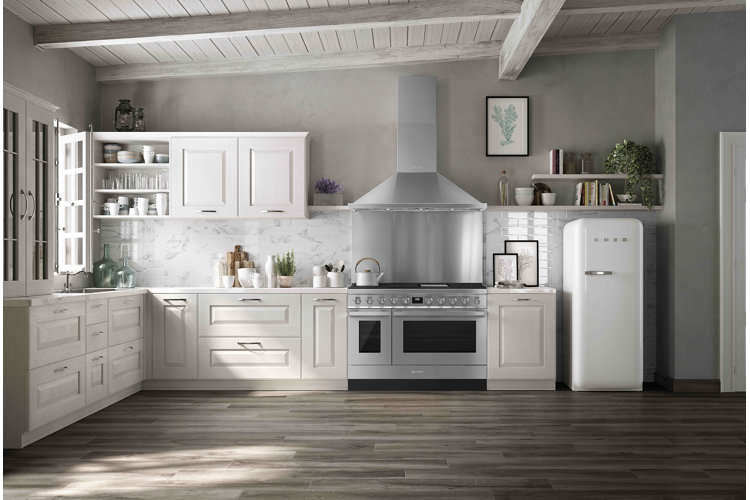
Whether you're updating, upgrading, or remodeling your kitchen, a range hood is a necessary partner for your stove. Range hoods remove cooking smells, heat, condensation, and grease – preventing these from accumulating on your ceiling or elsewhere in your kitchen. In this guide, we'll walk you through the types of range hoods so you can feel comfortable buying a range hood that is perfect for your space.
In This Guide
Types of Range Hoods
Choose a Range Hood Airflow Capacity
Find the Right Range Hood Size
Choose a Range Hood Vent/Exhaust Type
Choose a Range Hood Blower
Pick Your Features
Frequently Asked Questions
How to Buy a Range Hood
Understand the Types of Range Hoods
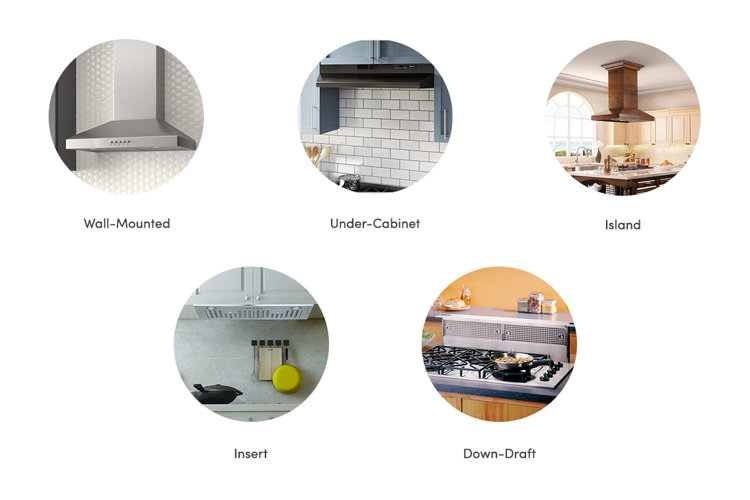
Range hoods can be mounted in five ways:
Wall-Mounted: Attached to a wall rather than to a ceiling or cabinetry, this range hood type is optimal if there's a break in your kitchen's upper cabinetry above your stove top. Wall-mounted range hoods are some of the most traditional-looking types of range hoods.
Under-Cabinet: The most commonly-used style of range hood, this slim option affixes to the bottom of your cabinetry over your range and can easily be integrated into your existing space.
Island:Also known as chimney hoods, these range hoods hang from the ceiling above a kitchen island. If your stove top is housed on your kitchen island, this is your best range hood option.
Insert: Essentially the guts of a hood without the housing, insert range hoods are designed to fit into a custom hood cover. These range hoods are optimal if you have an unconventionally-shaped kitchen or if you want to ensure that your range hood fits in with your kitchen's unique style. Many insert range hoods are ducted, but some super subtle models are ductless. Ductless insert range hoods aren't as powerful as ducted models, but they can be placed right up against the bottom of a cabinet and tend to be easier to install.
Down-Draft: Many down-draft hoods aren't actually hoods at all; instead, they are flat panels that are installed beside or behind the stove top. These range hood models are most often used when a range is situated in an awkward area, like in front of a window. Down-draft range hoods are less visually intrusive than traditional range hoods. Some high-tech models are even designed to descend into the countertop when not in use.
(Shop This Image: stainless steel wall-mounted range hoods, stainless steel gas ranges, copper cookware sets, white wood floating shelves, wood cutting boards)
Buying a range hood with the right airflow capacity is essential as this changes how much hot air rising up from the stove your range hood can handle. Airflow capacity or range hood strength is the amount of air removed from the kitchen in the span of one minute — measured in cubic feet per minute, (CFM). The higher the CFM, the greater the airflow. A range hood's CFM should align with a range's total British thermal units (BTUs), which in this case represents the combined output of heat from stove burners.
You should plan for 100 CFM per 10,000 BTUs. A lot of times you can find the total BTU output for your kitchen range in the product manual, but on Wayfair's website, you can find it under the specifications tab on product pages. For example, if you know your kitchen range has a total output of 40,000 BTUs (say 10,000 per burner), then you should be looking at range hoods with 400 or more CFM.
With this in mind, there are a number of factors to consider when deciding on the minimum CFM required for your needs:
Electric or Gas Range: An electric stove needs at least 300–450 CFMs, while a gas range will require 600–1,200 CFMs for optimum operation. For an exact measurement of a gas range's minimum fan strength, check with your range's manufacturer. Determine the amount of British thermal units (BTUs) your range has and divide that number by 100.
Range Size: Ranges with more burners will need stronger range hood fans to ensure proper ventilation when most or all burners are in operation. When in doubt, add the total number of BTUs put off by each burner and divide by 100, so you know for sure how many CFM you'll need when all burners are turned on and in use.
Frequency of Use: If you cook often or tend to use multiple burners at once, you will need a stronger fan to handle the increased heat, so keep that in mind when choosing the best range hood for your home.
Room Size: Larger kitchens require a stronger hood fan to account for the increased air space. You can easily find the minimum CFM needed for your kitchen's square footage by multiplying your kitchen's total cubic feet by 15 and then dividing by 60 (the number of minutes in an hour).
Noise Levels: A common complaint about range hoods is their noise output, which can be influenced by the range hood's airflow capacity. This noise is typically measured in units called sones, but some manufacturers may provide sound levels in decibels. The average range hood has between two and six speed settings. The low setting should reach about three sones (about 40 decibels), which is about the same sound level as a running refrigerator. The loudest hood ranges (due to their higher CFMs) will max out at seven or eight sones (about 56 to 57 decibels). This equates to roughly the same noise level as traffic. If you're concerned about noise level, shop for range hoods with a quiet mode.
Tip!
The blower type also impacts the noise level. To learn more about that, read the "Choose a Range Hood Blower Type" section below.
Find the Right Range Hood Size
(Shop This Image: white range hoods, white electric ranges, stainless steel cookware sets, knife block sets, wood cutting boards, white utensil crock)
Range hood size is extremely important as it needs to fit your space properly.
Range Hood Width: Use a tape measure to record the width of your range or cooktop. If you are getting a wall-mounted, under cabinet, or insert mounted range hood, also measure the width of your cabinets. Choose a range hood that's at least as wide as the stovetop or cooktop, but preferably one that's three inches longer on both sides so it extends past the sides of the stovetop. This ensures the range hood catches any steam or heat escaping out the side. See below for the most popular range hood widths.
Range Hood Height: You want to make sure your range hood isn't just the right width, but also sits at the right height so there is enough space between the bottom of the range hood and the surface of your cooktop. It should be high enough to ventilate properly, yet low enough to catch and absorb the steam. Typically electric ranges require a matching range hood to be about 20" to 24" inches above the stove, while gas ranges need a range hood placed 24" to 30" above the stove to accommodate burners with open flames. When in doubt, refer to the range hood product manual for specific placement instructions. To figure out how high your range hood should be, measure from the ceiling to the top of your cooktop and subtract the numbers listed above (20"— 24" or 24"— 30") depending on the type of cooktop you have.
Range Hood Depth: Before you choose a range hood depth (from front to back), measure the depth of your range or cooktop. Your range hood should be the same depth to ensure it covers all the burners.
Here are the most popular range hood widths:
20" & 24": 20" & 24" range hoods are typically smaller and more narrow in size, making them the perfect counterpart for small apartment ranges. Pair a 20" range hood with a 20" range for small space cooking. Have some space to spare? Pair a 24" range hood with a 20" range for even more ventilation.
30" & 36": Choose a 30" or 36" range hood for a more standard size option. 30" range hoods work best with an equivalent 30" range, while a 36" range hood can go with either a 30" range (if you have the room), or a 36" range for a well-balanced look.
42" & 48": Slightly above average size, 42" and 48" range hoods are ideal for larger kitchens or for making a statement above a kitchen island cooktop.
54" & 60": These range hood sizes pair well with large ranges that feature double ovens and stovetops. Pair a 54" range hood with a 48" or 50" range or a 60" range hood with a 54" range to catch the maximum amount of steam, heat, or odors from the stovetop below.
(Shop This Image: black gas ranges
, wood cutting boards, white kitchen canisters & jars, white mugs & teacups, stainless steel automatic coffee makers)
There are three types of range hood venting options:
Ducted: Ducted range hoods vent air and irritants out of the house via a duct. Installing a ducted range hood is a complex process that involves drilling vent holes into your wall that lead to the outside of your home. Ducted range hoods are typically the best range hoods for effectively removing irritants and cleaning air. We recommend working with a professional to install a ducted range hood.
Ductless: Ductless range hoods, also called ventless range hoods, do not require ductwork – which allows you to place this range hood almost anywhere. For example, above a kitchen island. These types of range hoods do not remove the air, but instead filters air by using internal fans to recirculate the cleaned air back into your kitchen. Because they are ductless, these range hoods are easier to install than ducted range hoods. You will need to regularly clean the filter to ensure it continues to work properly.
Convertible: Convertible range hoods are range hoods that can function as ductless units but are also compatible with ducts if necessary. To use a convertible range hood as a ductless range hood, you must install special charcoal filters. You might want to purchase a convertible range hood in place of a ducted or ductless range hood if you know you want a range hood but aren't quite sure which type you'd like. A convertible range hood would allow you the option to test out a ductless range hood. Then, if you so desire, you can convert it to a ducted range hood at a much lower price than what you'd pay to replace a ductless range hood with an all-new ducted range hood.
(Shop This Image: stainless steel wall-mounted range hoods, stainless steel gas ranges, gold pot fillers, wood cutting boards, wood floating display shelves, white utensil crocks, white pots, patterned backsplash tile)
A range hood blower is the mechanism that includes the fans and filters. In short, the blower does all the work. In this section, we explain the different blower types available and what impact each might have on the sound of your range hood. A range hood is different from a range hood exhaust in that a blower handles filtration and ventilation while the exhaust is where the filtered air or irritants are emitted.
Exterior Unit: An exterior unit is located on the roof or exterior wall of the home. Although relatively large, these blowers are a somewhat quieter option since the fan is farther away from the kitchen.
Interior Unit: Interior units are installed in the hood itself. While these blowers tend to be a bit noisier than exterior units, they are easier to install and service if needed.
In-Line Unit: Placed in a range hood's duct, an in-line blower is mounted outside of the range hood but inside the home (often in either a basement or attic). Eliminating the need for a bulky blower on the exterior of the home, this option is both aesthetically pleasing and relatively quiet compared to interior units.
(Shop This Image: yellow ranges, white subway wall tile, silver dome ceiling lights, glass kitchen canisters, silver kitchen canisters)
Wireless Capabilities: Some range hoods are compatible with Wi-Fi and/or Bluetooth, allowing you to take control from a Wi-Fi/Bluetooth-connected device. Others come with a remote control so you don't have to reach too far to operate your range hood.
Heat-Sensing: Heat-sensing range hoods automatically set their fans to higher speeds when they detect an increase in temperature. Some models even alert you when they detect dangerously high temperatures.
Night-Light: No one likes cooking in the dark. Some range hoods have built-in night-lights, also called task lights, that illuminate the area beneath them. This handy feature can make a big difference in your ease of cooking after dark, especially during winter, when daylight hours are limited.
Digital Control: Easy to read and easy to control, range hoods with digital displays are next-level. If you're a fan of all things sleek and high-tech, a digital-control range hood is the range hood for you.
Frequently Asked Questions
What are the main types of range hoods?
The main types are wall-mounted, under-cabinet, island, insert, and down-draft range hoods.
How is range hood airflow capacity measured?
Airflow capacity is measured in cubic feet per minute (CFM).
What is a convertible range hood?
A convertible range hood can function as ductless or be converted to use ducts if needed.
