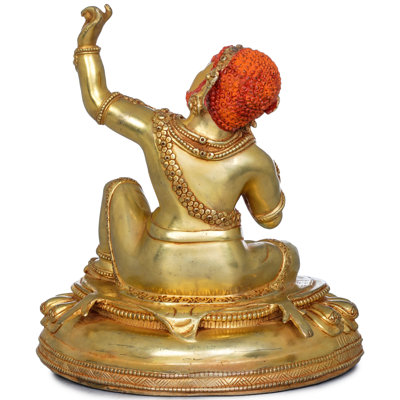
The goddess is standing on a high platform, decorated with lotus petals. On her head is a conical mukut or crown, signifying her divine status. Numerous texts have exhausted themselves in describing the celestial beauty of Uma, the goddess who captured the heart of the ascetic god Shiva. Her eyebrows have been compared to the crescent moon, her eyes like the lotus petals, and her face gleaming like the sun and moon combined. The statue here has portrayed a divine tranquillity on the face of the goddess, who is standing in the Tribhanga (triple bent) posture. The physical appearance of the goddess is voluptuous, with rounded breasts, a thin waist, and lean arms and legs. Her left-hand rests near her leg in the graceful Lolahasta mudra, a posture that mimics the tail of a horse. The right hand of the Devi is raised, probably to hold a lotus or lily. Goddess’ waist is wrapped in a jeweled griddle and she is wearing a simple dhoti whose folds are represented by the semi-circular carvings of the statue. Uma bronze statues like the one we have here are often a part of a Shiva- Parvati or Shiva Parivar composite. She is known as Shivagami (beloved of Shiva), Tripursundari (the beauty of three cities), Bhogeshwari (the goddess of desire), or simply Devi depending upon the context. As an independent deity, Uma rules the spheres of desire, fertility, abundance, and motherhood.