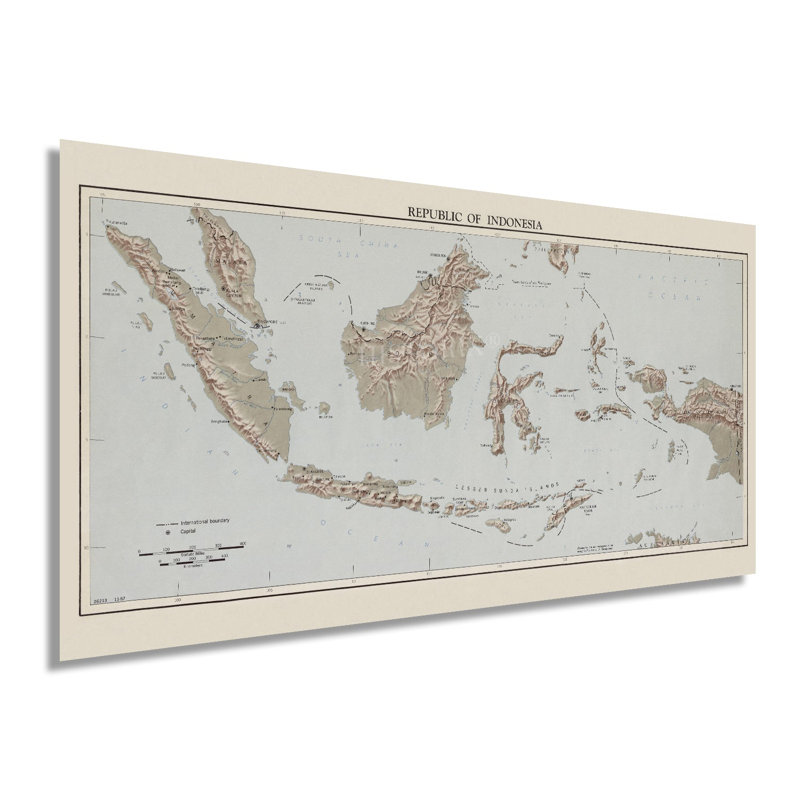
The years following the conclusion of World War II saw Indonesia moving away from democratic leadership toward a more authoritarian rule of law under President Sukarno. Though the Dutch attempted to regain control of Indonesia after the war, independence was recognized internationally in 1949. Following the Japanese surrender, many nations that had been under Japanese control gained independence and formed new governments despite rather divisive political, social, and religious beliefs. Indonesians unified under a national identity that rallied under democratic elections and economic, cultural, and political autonomy. Sukarno would remain an influential political figure for the next four decades, and his New Order policies encouraged foreign investment, which allowed the nation to experience a period of significant economic expansion.The Central Intelligence Agency began producing international geopolitical maps in 1941 to represent the most accurate boundaries, borders, and political regimes across the globe. These maps were invaluable sources of information for military and political leaders to strategize while developing and implementing foreign policy. The 1950s saw significant cultural transitions as the tensions of World War II gave way to the Cold War. Sukarno would remain in power until the fall of the New Order in 1998. This map's distinctive style is immediately recognizable as a CIA production with signature details and a minimal aesthetic. These pieces of cartographical history are distinguished from civilian productions by their consistency and attention to specific information relating to international policy. 1957 was a period of significant growth and transformation throughout Indonesia and Southeast Asia.Our museum quality giclee print comes printed with archival ink on premium heavyweight matte paper. This eye-catching vintage map reproduction makes the perfect gift for anyone that loves history and imagery.


 or