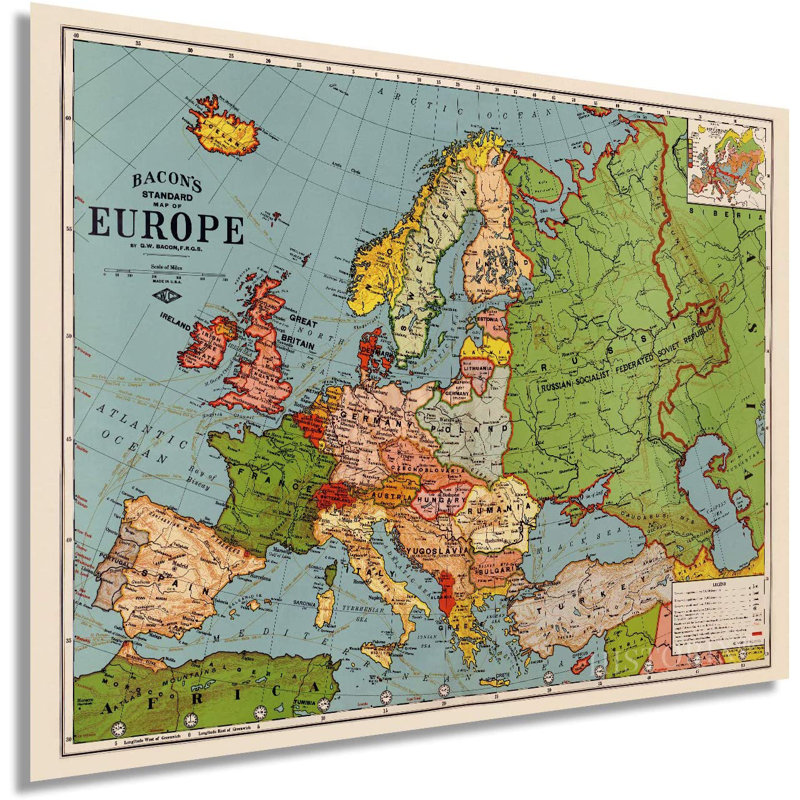
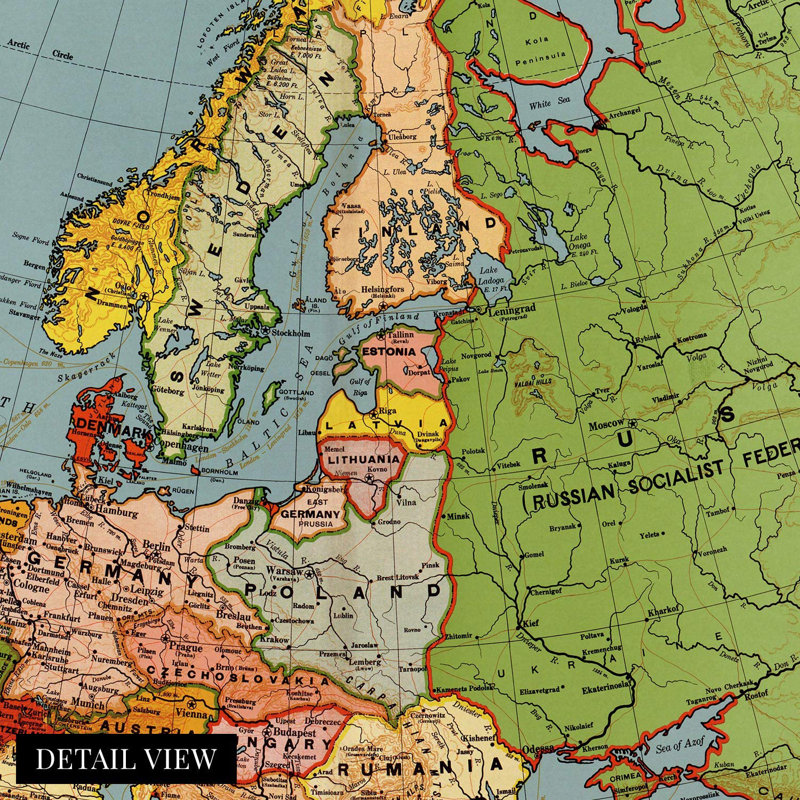
This distinctive illustration of Europe in 1925 bears the aesthetic of American cartographer George Washington Bacon, whose unique style would remain in vogue until the mid-1950s. Produced only six years after the Treaty of Versailles officially ended World War I, this map depicts Europe in a period of significant transition and growth. While the United States was experiencing the so-called ‘Roaring Twenties,’ with fashion and societal progressiveness, Europe was starting to rebuild after the devastation of the War. This rebuilding would allow countries like France to experience a renaissance of the arts, literature, and cultural dynamism. The War had an unintended consequence of causing an economic boom, and by 1925 this boom was felt throughout Europe, and nations were flourishing. National boundaries were re-established following the War, with Poland emerging as a sovereign nation, as well as the foundation of the multinational state, which would eventually become Yugoslavia. Czechoslovakia was formed by merging the former Kingdom of Bohemia with parts of the Kingdom of Hungary to become yet another new independent nation. Russia became the Soviet Union and Finland, Estonia, Lithuania, and Latvia received independence. In many ways, the eruption of World War I marked the transition of Europe, and the rest of the world into modernity. The War saw the last to see horses in combat and the first to see aviation used in military campaigns. This unique depiction of Europe in this period is immediately recognizable and is truly an authentic piece of cartographical history.
 or
or