Skip to Main Content
Sign In
Sign In
HISTORIC PRINTS Logo

HISTORIC PRINTS

4.7

Rated 4.7 out of 5 stars.

HISTORIC PRINTS

268 Results

Sort by
Recommended
" Vintage 1864 Richmond Virginia Map "
Available in 2 Sizes

" Vintage 1864 Richmond Virginia Map "

by HISTORIC PRINTS

24" H x 36" W x 0.1" D
$98.99

Free shipping

Illustrated by noted German-born lithographer and artist Augustus Kollner this unique depiction of New Jersey's State Capital and one of the earliest established cities in North America shows Trenton, NJ, in a period of significant growth and transformation. First established in 1679 as a Quaker settlement, Trenton has a rich history and deep connections to America's formation. It was the site of Washington's first victory over Hessian troops in 1776 and continued to play a pivotal role during the War of 1812 and the American Civil War. European immigrants flocked to the city during the nineteenth century, and by the middle of the 1800s, Trenton had experienced a population boom spurred on by thriving pottery and wire rope industries. These immigrants established neighborhoods and communities along cultural lines, and many still exist to this day. Though New Jersey saw no battles during the Civil War, it supplied nearly ninety-thousand troops for the Union Forces and was an essential provider of munitions and agricultural products. Trenton's direct border with Philadelphia was significant as it developed throughout the nineteenth century and became part of the greater Philadelphia municipality. Trenton's location on the Delaware River allowed for a thriving import and export industry, which further diversified Trenton's population. Kollner was based in Philadelphia and became well known for his landscapes with works in the Pennsylvania Academy of Fine Art. This rare depiction of Trenton is immediately recognizable and transports the viewer back in time, creating an indelible link between past and present.

    Opens in a new tab
    1896 Louisiana Map Poster Wall Art on Paper
    Sale
    Available in 2 Sizes

    1896 Louisiana Map Poster Wall Art on Paper

    by HISTORIC PRINTS

    24" H x 36" W x 0.1" D
    $92.99$101.99

    Free shipping

    Produced by the prolific mapmaker Rand Mcnally, this railroad and transportation map of Louisiana in 1896 depicts the state in a time of great transition as reconstruction and the turn of the century approached. The Mississippi River had long been a crucial trade route for getting goods into the midwest. The main entry at New Orleans had kept the iconic American city thriving, and the 1890s were no different. People from across the globe came through the city, and its French roots mixed with local Creole culture had developed into a distinct melting pot found nowhere else. During the Civil War, the capture of the Mississippi by Union forces marked a turning point in the war, and Union victory became apparent due to the significant importance of the river to Confederate forces. The late 20th century saw significant advances in shipbuilding, and the proliferation of locks, levees, and dams along the river started. Much of this engineering occurred to keep the river from shifting into the Atchafalaya River, thus bypassing New Orleans. The acquisition of Louisiana, as negotiated in 1803, included a vast amount of North American territory. France was engaged in multiple conflicts and needed capital to finance these clashes, allowing the new nation to acquire 828,000 sq mi of land for fifteen million dollars. The purchase would become a pivotal part of the American notion of Manifest Destiny and redefine the geography and geopolitical landscape of America. This map is truly an authentic piece of cartographical history.

    • Overall Depth - Front to Back: 0.1''
    Opens in a new tab
    1831 Bucks County Pennsylvania Map Poster Wall Art
    Available in 2 Sizes

    1831 Bucks County Pennsylvania Map Poster Wall Art

    by HISTORIC PRINTS

    32" H x 24" W x 0.1" D
    $96.99$99.99

    Free shipping

    One of the three original counties founded by William Penn in 1632, Bucks County, has a rich history and deep roots in American History. Published by prolific American cartographer and engraver Henry Schenck Tanner in 1831 during what is considered the "golden age" of American mapmaking, this is truly an authentic piece of cartographical History and unique depiction of the past. During the American Revolution, General Washington and his troops camped in Bucks County as they prepared to attack Hessian encampments in Trenton, NJ. They crossed the Delaware River on December 26, 1776, and defeated Johann Rall and his troops in the Battle of Trenton; this victory marked a turning point in the War for Independence and was commemorated in 1917 with the opening of the Washington Crossing Park, where 13 historic structures stand to this day. Immediately Northeast of Philadelphia, this depiction shows the region in a time of considerable growth and prosperity. As Philadelphia grew, immigrants and residents moved into the town of Bensalem, the largest in Bucks County. In the early 19th century, the rise of manufacturing jobs spurred population growth. One of the most iconic estates in Pennsylvania, Andalusia, or the Nicholas Biddle Estate is found in Bensalem, and the Greek Revival architecture is one of the most excellent examples in the United States. Pennsylvania's rich heritage goes back as far as any place in American History, and Bucks County is deeply rooted in this legacy.

    • Overall Depth - Front to Back: 0.1''
    Opens in a new tab
    1893 Hawaii Map Poster Wall Art on Paper
    Sale
    Available in 2 Sizes

    1893 Hawaii Map Poster Wall Art on Paper

    by HISTORIC PRINTS

    24" H x 36" W x 0.1" D
    $92.99$101.99

    Free shipping

    The 1890s were a time of significant transition for the Hawaiian Islands, and the depiction of the iconic archipelago in this 1893 publication transports the viewer back in time. Printed just five years before The United States would annex the island chain, the area was already being transformed by a thriving sugarcane farming industry, and vast fortunes were being made. 1893 marked the overthrowing of the last monarch following her attempt to ratify a new constitution granting her absolute authority, and a provisional government was formed. This map was published before the five years when Hawaii was recognized as a sovereign nation, one of two states in the Union to have done so. The Islands were first documented in 1778 by British explorer Captain James Cook and were dubbed The Sandwich Islands. Cook was killed by natives on the island in 1779 following a dispute over the theft of a small ship. The storied history of the islands has captivated American tourists for years, and tourism has always been a primary economic driver. The 1890s saw advances in sea travel, and the ability to quickly cross vast oceans opened the islands up to visitors. Tales spread through mainland America after authors Mark Twain and Jack London experienced the local tradition of ‘wave sliding’ or surfing. This topographical map represented the vanguard of depth maps, with soundings being laboriously produced by vessels in coastal waters and surveyors using the latest technology to indicate the heights of the mountain; this an authentic piece of cartographical history.

    • Overall Depth - Front to Back: 0.1''
    Opens in a new tab
    Sale
    Available in 2 Sizes

    1773 South Carolina Map Poster Wall Art on Paper

    by HISTORIC PRINTS

    16" H x 16" W x 0.1" D
    $61.99$65.99

    Free shipping

    Published just two years before the American Revolution broke out, this depiction of what would become South Carolina is highly detailed and would have been a valued resource at the time. By illustrating not just the towns and counties, but also topographical information, this map serves as a real link to the past and an authentic piece of cartographical history. This era in South Carolina, and the other twelve colonies, saw tensions rising against colonial rule by Great Britain, and the Boston Tea Party occurred in the same year this map was produced. Charlestown, the oldest and most populated city in South Carolina, was a valuable port and the busiest hub of Atlantic trade between the colonies and England. In addition, the huge amount of business that occurred in Charlestown made it the most prosperous city in North America at this time. Tobacco exports flourished, and the state developed widespread rice cultivation in its marshy lowlands. South Carolina’s rich history goes back to the first settlers of the land who found fertile ground for farming as well as valuable marine life and the ability to establish deepwater ports. Five years after the publication of this map South Carolina would be the first state to ratify the Articles of Confederation and would go on to become the eighth state to join the fledgling nation. During the American Revolution, the state saw nearly a third of all conflicts on its land, more than any other state, as residents endured invasion by the English.

    • Overall Depth - Front to Back: 0.1''
    Opens in a new tab
    Available in 2 Sizes

    " 1879 Halifax Nova Scotia Canada Map "

    by HISTORIC PRINTS

    36" W x 24" H
    $98.99

    Free shipping

    Produced by one of the pioneers of nineteenth-century cartography, Albert Ruger, this stunning depiction of Halifax shows the iconic city in a period of significant growth, transformation, and development. Ruger was an early adopter of the birds-eye perspective style and helped create the unique aesthetic that is immediately recognizable and creates an indelible bond between the past and present for the viewer. Not only was Ruger involved with the expansion of this style, but he was also one of the most prolific birds-eye perspective illustrators, and his works are considered among the best examples of these depictions. Because they were produced to promote a city's notable civic and geographic features and were not drawn to scale, these artists were given greater freedom to express the regions' distinct characteristics and progression throughout the late nineteenth century. As the Capital of Nova Scotia, Halifax is centered around the harbor and has had a significant presence in Atlantic Canada since its establishment in 1749. By the time of this publication in the 1870s, the city was experiencing a period of considerable prosperity and expansion as immigrants flocked to the region for work in the fishing, mining, and logging industries.The establishment of Halifax led to the outbreak of Father le Loutre's War which began when Edward Cornwallis arrived from Britain with nearly twelve hundred settlers to claim the region for the Crown. This detailed depiction is truly an authentic piece of Canadian cartographical history by one of the masters of the style.Our museum quality giclee print comes printed with archival ink on premium heavyweight matte paper. Shipped in a sturdy cardboard tube your print will arrive ready to be framed. This eye-catching vintage map reproduction print makes the perfect gift for anyone that loves history and imagery.

      Opens in a new tab
      Available in 4 Sizes

      " 1911 George Washington At Valley Forge "

      by HISTORIC PRINTS

      8" H x 10" W x 0.01" D
      $43.99

      Free shipping

      This classic depiction of the Commander of the Continental Army and First President of the United States, George Washington, shows the iconic founding father during the height of the American Revolution at his headquarters in Valley Forge, PA. Continental troops were suffering from bitterly cold conditions and a lack of necessary supplies, though their spirits remained high as they battled the British for freedom from colonial rule. Some 12,000 troops camped at Valley forge during the winter of 1777, and this tribute was painted in 1911 by noted American artist E. Percy Moran and remains an enduring symbol of early American history.Born in Philadelphia in 1862, Moran was the son of English immigrants who had come to the United States in the early nineteenth century. His father was also an artist and taught Moran at the Philadelphia Academy of Fine Arts. Moran became known for painting historical scenes, and this depiction of Washington remains one of his most famous pieces as it represents a pivotal moment in the American Revolution. Moran's classic style and aesthetic were very popular in the early twentieth century and tended to mirror his traditional subjects of early American history and pastoral landscapes.This remains one of the most paintings of Washington and his ability to inspire American troops throughout the Revolutionary War. The painting draws the viewer in and creates an indelible bond between the past and present. Moran frequently chose Washington as the subject of his work; this remains the most recognized piece.

        Opens in a new tab
        Sale
        Available in 4 Sizes

        " 1828 President James Monroe "

        by HISTORIC PRINTS

        18" W x 24" H
        $72.99$77.99

        Free shipping

        Fifth President of the United States, James Monroe, was the last of the Founding Fathers to serve in the office as well as the final President of the so-called Virginia dynasty. His greatest legacy, the Monroe Doctrine, opposed European colonialism in North America and asserted the United States' dominion over the American west leading to further settlements. Monroe, under third President Thomas Jefferson's tutelage, successfully negotiated the Louisiana Purchase in 1803, which doubled the claimed territory of the United States. Monroe was born in Virginia and served in the Continental Army during the American Revolution.Monroe served as fourth President James Madison's Secretary of State during the War of 1812, and his service made him the obvious choice for the Presidency in the election of 1816. Monroe was responsible for bringing statehood to Florida and Missouri, and his policies were conciliatory towards the British while hostile towards Spanish expansion into North America. Monroe was elected Senator in 1790 but left his post in 1794 to serve as the Ambassador to France under first President George Washington. During Monroe's first term as President, the opposing Federalist Party collapsed, ensuring his victory in the subsequent election in 1820.This print produced by American artist Gilbert Stuart is another link to America's political history as Stuart had produced portraits for all four preceding presidents establishing a tradition that remains to this day. The distinctive style and classic aesthetic make this piece a part of American history that links the viewer to the past.

          Opens in a new tab
          Available in 2 Sizes

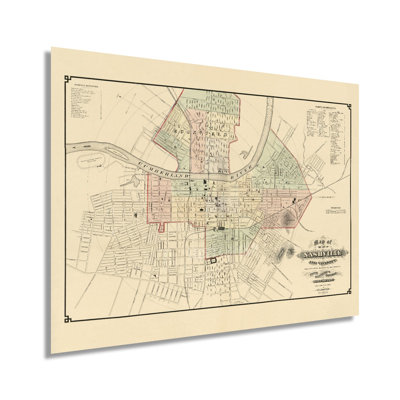
          " 1877 Nashville Tennessee Map "

          by HISTORIC PRINTS

          18" H x 24" W
          $70.99

          Free shipping

          Published during a period of rebuilding and growth, Tennessee’s State Capital of Nashville has a rich history, unique culture, and this depiction offers a window into its development and evolution. In the decade following the conclusion of the Civil War, Nashville experienced a population boom as a robust local economy expanded due to increased manufacturing jobs, a busy inland port on the Cumberland River, and the number of residents grew exponentially in the latter parts of the nineteenth century. The city had been the site of a bloody clash between Union and Confederate forces in 1862 and was controlled by the Union until the end of the war in 1865. Another significant Confederate loss occurred in 1864 with the defeat of Confederate General Hood in what would become a turning point in the conflict.Compiled by Massachusetts-born Wilbur F. Fisk, who had relocated to the city in 1851 at the age of seventeen to begin his career as a surveyor and cartographer. Nashville was charted in 1806 and became a political, commercial, and financial center of Tennessee, given its central location and proximity to a major waterway. Nashville became the permanent State Capital in 1843, with the capital building being completed in 1859. Citizens throughout the south flocked to Nashville both during the Civil War and in the decades following as jobs were plentiful and it was safer than the surrounding countryside. The distinctive aesthetic and minimal style immediately transports the viewer back in time, creating an indelible bond.Our museum quality giclee print comes printed with archival ink on premium heavyweight matte paper.

            Opens in a new tab
            Available in 2 Sizes

            " 2021 Oceania Map;2021 Oceania Map "

            by HISTORIC PRINTS

            18" H x 24" W
            $71.99

            Free shipping

            Comprised of an extensive array of islands, archipelagoes, and Australia, Oceania is a culturally, geographically, and biologically diverse region marked by distinct cultures developed over centuries of oceanic exploration and the eventual colonization of Australia by the British. Europeans first explored the area in the sixteenth century with Portuguese expeditions that reached the Tanimbar Islands west of Papua New Guinea. Captain James Cook would conduct more extensive expeditions throughout Oceania during the eighteenth century and is credited with being the first European Hawaii. The region has a unique blend of economies from major markets in Australia to society that remain largely agrarian and less modern. Further development would occur throughout the twentieth century as the Pacific Theater of World War II caused the extensive establishment of US Naval, Air Force, and Army bases in strategic points across Indonesia and smaller islands that aimed to defeat Japanese forces. Polynesians were granted French citizenship in 1946 following the conclusion of the war and changed the island's status to overseas territory of French Polynesia. The Pacific Islands Forum spawned from the South Pacific Forum in 2000 and represented the political interests of the smaller island nations on a global level. The Central Intelligence Agency began producing geopolitical maps in 1941, and these depictions are considered the most accurate representations. Political and military leaders utilize them to develop policy and strategy. This is an immediately recognizable piece of modern cartographical history that illustrates one of the most unique regions on the planet.Our museum quality giclee print comes printed with archival ink on premium heavyweight matte paper.

              Opens in a new tab
              Available in 2 Sizes

              " 1891 Greensboro North Carolina Map "

              by HISTORIC PRINTS

              24" W x 16" H
              $62.99$67.99

              Free shipping

              Following his early forays into the form, Albert Ruger partnered with J.J. Stoner to form the imprint Ruger & Stoner that produced this stunning depiction of Greensboro in the decade before the turn of the twentieth century. By the 1890s, Greensboro had rebuilt its industrial and milling facilities and was enjoying a period of significant growth and prosperity. By 1900 the city was considered the center of the Southern textile industry. Significant numbers of immigrants flocked to the town, establishing neighborhoods and communities along cultural lines, many of which exist to this day. During this period, several architecturally significant civic buildings were completed, which remain popular attractions. Birdseye perspectives were widely popular during the nineteenth century and bear a signature style and distinctive aesthetic that immediately transports the viewer back in time, creating an indelible bond between the past and present. Ruger & Stoner were pioneers of the style, which served to attract residents and merchants alike by promoting prominent civic buildings, religious and educational institutions, and economic opportunities. This panoramic map depicts the city in a transitional time as it grew from a village to an important economic and cultural hub for the region. As the nation neared the turn of the century, considerable technological and cultural transformations shaped American society. The Gilded Age created substantial economic growth, and Greensboro became one of the South's most important and noted cities. Greensboro also developed as a significant educational center for the State and is home to two major public research facilities.Our museum quality giclee print comes printed with archival ink on premium heavyweight matte paper. Shipped in a sturdy cardboard tube your print will arrive ready to be framed. This map reproduction print makes the perfect gift for anyone that loves history and imagery.

                Opens in a new tab
                Available in 2 Sizes

                " 1889 Orange County California Map Poster "

                by HISTORIC PRINTS

                24'' W x 24'' H
                $85.99

                Free shipping

                Produced only two years following the discovery of gold in the Santa Ana Mountains, Orange County was experiencing a boom in population and economic growth. This was spurred by settlers flocking in on the Santa Fe and Southern Pacific Railroads. This map was also published the same year that the county gained a referendum to be renamed and secede from Los Angeles County. Produced by prominent Civil Engineer and resident Colonel Solomon H. Finley, this map’s minimal aesthetic and unique style are a prime example of civic cartography for the era. Characterized by bold colors in contrast and crisp stark lines, these depictions are remarkable pieces of nineteenth-century American history.Finley would go on to become an important political figure in the county during the early parts of the twentieth century and eventually became mayor. Finley also negotiated the land acquisition deal that would eventually also for the establishment of modern-day Huntington Beach. The region would experience significant growth in 1904 following the completion of the Pacific Electric Railway, which would expand economic opportunities across Southern California. The region retained a thriving agricultural economy throughout the early twentieth century. Following the conclusion of World War II, the region experienced an economic transformation and became a center for the thriving aerospace industry.Nestled between San Diego and Los Angeles, Orange County became the quintessential picture of Southern California. This map hearkens to a different time, and its indelible style immediately transports the viewer back in time, an authentic piece of cartographical history.Our museum quality giclee print comes printed with archival ink on premium heavyweight matte paper. This eye-catching vintage map reproduction print makes the perfect gift for anyone that loves history and imagery.

                  Opens in a new tab
                  Available in 2 Sizes

                  " 1889 Catskill NY Map "

                  by HISTORIC PRINTS

                  24" H x 36" W
                  $89.99$101.99

                  Free shipping

                  Produced by one of the most prolific map illustrators of the nineteenth century, Lucien Burleigh, this stunning depiction of Catskill bears a unique aesthetic and distinctive style that immediately transports the viewer back in time. More than one hundred and sixty of his works have been included in the Library of Congress, and his career spanned more than four decades. The birds-eye perspective was a widely popular style in the nineteenth century and was used to promote notable civic features to attract residents and merchants alike. Because these were not intended to be accurate maps for geographical purposes, the sense of scale is often distorted, giving them their signature look.First settled in 1680, Catskill was officially established in 1788 and would go on to incorporate Woodstock in 1800. Located on the banks of the iconic Hudson River, the city became a popular destination for New Yorkers looking to escape the bustle of the town during the summer months. Settlement in the region was spurred by Dutch immigrants who established numerous mills and other manufacturing plants that would thrive during the nineteenth century.The Catskill Mountains are known for their pastoral beauty, numerous rivers and lakes, and vast forests that attract visitors during the changing of the seasons. Though the town contained only ten houses at the conclusion of the American Revolution by 1889, it had grown significantly and was the county seat of Greene County. This is an authentic piece of American cartographical history by one of the most prolific illustrators.Our museum quality giclee print comes printed with archival ink on premium heavyweight matte paper.

                    Opens in a new tab
                    Available in 2 Sizes

                    " 1875 Kingston New York Map "

                    by HISTORIC PRINTS

                    24" H x 36" W x 0.01" D
                    $86.99$101.99

                    Free shipping

                    Produced and published by one of the most prolific cartographers of his time, Lucien Burleigh, this depiction of the iconic upstate New York town of Kingston bears a unique style and aesthetic that is immediately recognizable. Burleigh’s work is included in the Smithsonian American Art Museum as well as the Boston Public Library archives. Panoramic maps were widely popular during the late nineteenth and early twentieth centuries and served as marketing materials to attract residents and merchants alike. They featured prominent civic and economic features that drew immigrants from across America and Western Europe. The ornate flourishes and attention to detail make these authentic pieces of American cartographical history that link the viewer to the past.Located on the western banks of the Hudson River, Kingston’s rich history dates back to the Colonial era, and it was the first State Capital of New York. The geographic location made it a transportation hub for coal mined in Pennsylvania that traveled down the river to markets in New York City, some ninety-one miles to the South. The city was burned by British Troops following the Battles of Saratoga. This depiction shows Kingston in a period of significant prosperity in the decade following the American Civil War.Manufacturing and shipping had spurred the local economy, and by 1875 numerous industries were thriving. The city is home to three distinct historically recognized neighborhoods known for their architecture and regional significance. This is an authentic piece of American cartographical history with a striking appearance.Our museum quality giclee print comes printed with archival ink on premium heavyweight matte paper. This eye-catching vintage map reproduction print makes the perfect gift for anyone that loves history and imagery.

                      Opens in a new tab
                      ServerT:2.3869450092316