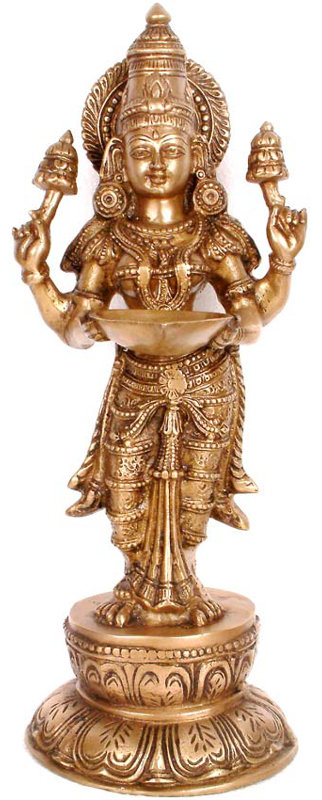
This brilliant piece of art, a brass statue with forty-inch height, anodised as glowing copper, represents Vairochana Buddha, one of the Buddha's lately evolved forms. The earliest example of Vairochana Buddha in arts is estimated to come from the seventh century in the form of a book-cover, now in Pritzker Collection. The book-cover image is in meditating posture, but later there evolved other forms of Vairochana Buddha; hence, the meditating Vairochana Buddha form is sometimes addressed also as Pritzker Vairochana Buddha.Vairochana Buddha represents one of the directional Buddhas of the Vajrayana pentad. Initially, the Buddha was conceived to have three forms : Sambhogakaya, that is, the body of bliss the regally adorned resplendent body claiming Buddha's spiritual majesty; Dharmakaya, that is, invisible, formless 'dharma' body; and, Nirmanakaya, that is, the mortal body of a monk. Subsequently, Vajrayana came out with a concept of five transcendental and directional Buddhas, who came to be known as the Vajrayana pentad. Vairochana Buddha was the centre amongst this pentad.