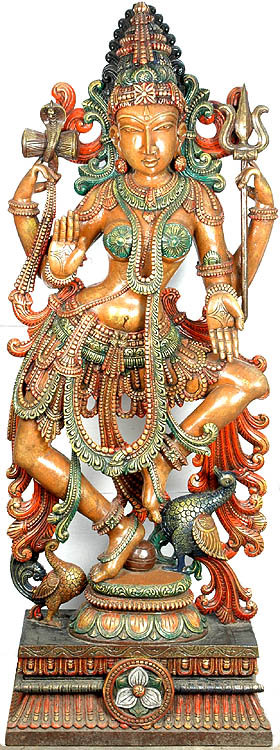
Deepalakshmi statues, both in Vijayanagara and Nayak styles, were cast with great minute details, sharp features with a blissful composure on the face, tall figures, a moderate size pan in hands worthy of use as a lamp and were highly embellished and bejewelled. In Nayak style, however, the lower garment of the figure rose from the foot up to the breasts, whereas in Vijayanagara it terminated on the waist. The upper parts of the figure were wide and large covered only by ornaments. The figure did not use a crown though her hair was beautifully and crown-like dressed. Deepalakshmi was initially conceived as a damsel and as such with just two hands carrying a lamp-like pan, but later the figure was also cast with multiple hands, four, six, eight or ten and with as many pans. This statue is obviously in Vijayanagara style. The word Deepalakshmi sounds like one of the several forms of the scriptural Indian deity Lakshmi, or Mahalakshmi, the consort of Vishnu, but save the name this icon hasn't any scriptural basis or even a reference in ancient Indian texts. Lakshmi has a scriptural tradition of her origin from the churning of the ocean and of her ten forms most of which she adopted as Vishnu's consort and obviously along with his incarnations, more significantly as Kamalodbhava with Vamanavatara, Bhumi with Parasuramasvatara, Sita with Ramavatara and Rukmani with Krishnavatara. None of these ten forms is Deepalakshmi. The Lakshmi concept, however, did not remain restricted to texts alone. In the course of time Lakshmi cult came to be more or less a tradition of faith, something between scriptures and folk, and was widely inclusive of things or entities that had its character. In popular faith, Lakshmi has been worshipped since ancient days as the goddess of riches, prosperity and fertility. Hence, the term Lakshmi is now for ages commonplace for anything or any person or who affects prosperity or wealth. It has been for such reasons that even a cow, and sometimes even cow-dung have been revered in Indian tradition as forms of Lakshmi for they both instrumented riches and fertility. Lakshmi of the house is the most commonly used epithet for a daughter and daughter-in-law. The Deepalakshmi statue, as an auspicious votive artefact, is, in the same way, an expansion of the Lakshmi cult for this too is an auspicious motif aimed at bringing prosperity and riches and is, thus, an artistic transformation or expansion of the ancient Lakshmi concept itself.