






Earn $7.20 in rewards, with 5% back¹, plus more exclusive perksEarn $7.20 in rewards, with 5% back¹, plus more exclusive perks
FREE Delivery
Get it by Sat, Nov 21
to:
By Exotic India
FREE Delivery
|
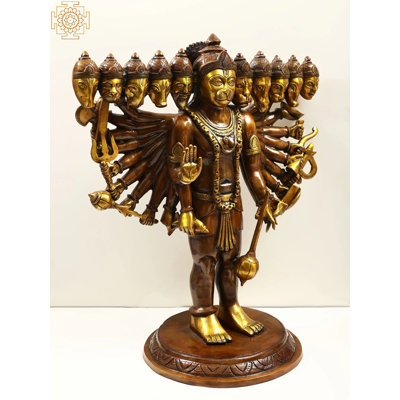
Invoke mighty protection, strength, and devotion with this grand 29-inch Brass Standing Panchamukhi Hanuman statue, meticulously handcrafted to depict the powerful five-headed form of Lord Hanuman revered for his courage and divine blessings. This striking representation embodies Panchamukhi Hanuman’s symbolism of conquering evil forces and providing unwavering support, making it an inspiring focal point for home altars, meditation spaces, or sacred sanctuaries. Crafted from premium brass alloy celebrated for its radiant golden luster and superior durability, the statue showcases intricate detailing on Hanuman’s five faces and majestic stance, merging ancient Indian artistry with lasting spiritual significance. The corrosion-resistant brass material ensures longevity and resilient beauty for both indoor display and sheltered outdoor settings. This statue is ideal for devotees and collectors seeking a commanding spiritual icon with deep cultural roots. Easy care through mustard or coconut oil application preserves its rich shine and craftsmanship, offering a long-lasting devotional treasure imbued with divine energies.
By Exotic India
FREE Delivery
|
O you shaggy-headed banyan tree standing on the bank of the pond,have you forgotten the little child, like the birds that havenested in your branches and left you?Do you not remember how he sat at the window and wondered atthe tangle of your roots and plunged underground?The women would come to fill their jars in the pond, and yourhuge black shadow would wriggle on the water like sleep strugglingto wake up. - Rabindranath Tagore The majesty of the Banyan tree depicted through this brass sculpture brings back memories of our childhood plays. The Banyan tree, known to be the Budha Raja or the Old King stays witness to so many generations growing under its shade. This metal tree with healthy branches, hanging roots and perching birds also have leaves coiled around its body like creepers. The brass body and leaves shining like precious metal signify the affluent status of the tree. Lotus flowers originating from the roots symbolise the rise of wisdom. This opus is all auspicious symbolism put in one place and a testament to the immortal existence of a Banyan tree.
By Exotic India
FREE Delivery
|
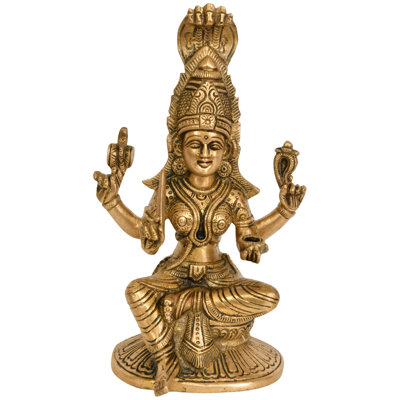
The governess of material aspects of the cosmos and the goddess of food and nourishment is ornately presented in this bronze ‘panchaloha’ sculptural image. As Annapurna, Parvati’s legend is famously popular – because of an argument where Shiva called food an inessential ‘maya’ of the universe, Parvati spitefully disappeared from the face of the Earth, prompting massive hunger and famine across societies, and it was only after the insistence of Shiva’s devotees that the supreme Brahman sought out his wife, finding her operating a kitchen in Varanasi under the form of Annapurna, and demonstrating the essentiality of her material gifts.
By Bungalow Rose
FREE Delivery
|
Ganesha here is presented as Narthan Vinayakara (in Tamil) or Nritya Ganpati- one of the 32 forms of the elephant god in Hinduism, where he is seen dancing vibrantly (narthan and nritya both suggest dancing). His posture and elegance remind one of the Tandava of Shiva and Laasya of Parvati. However, while Shiva dances to destroy and Parvati to create, Ganesha’s dance has not been endowed with such meanings. It seems as if our favourite Lord Ganesha dances to celebrate- to preserve and relish the life that occurs in between creation and destruction. This dance of Ganesha as the supreme reality has been a prime theme among the Ganpatayas- a sect based around Ganesha as their tutelary god, along the lines of the Ganesha Purana and Mugdala Purana.Coming to the outward features, the fabulous Karandamukuta (crown shaped like a pot) on Ganesha’s majestic head looks strikingly similar to a mountain. The well-known Indian poet Somadeva in his Kathasaritsagar has alluded to this similarity, comparing Ganesha’s head to the great mountain Meru (the centre of the Universe). Kirtimukha or the face of glory adorns the centre of the crown (also seen on the ornate waist belt of the lord). Tripunda (a distinctly Shaivite mark) can be seen on Ganesha’s forehead below the chains of the crown and a floral motif. His eyes are animated- looking at the idol from any direction will give you the feeling that you are under the omnipresent gaze of Ganesha. A bell is tied to his stylistically designed trunk. Imagine the sound it produces when the lord flings his trunk in the joy of dance! His ears, looking similar to a winnowing basket used in rural India even today, have birthed the belief that like the basket, Ganesha has the ability to separate the Gyan (useful) from the Agyan (useless). In his four hands, Ganesha has the goad, his broken tusk, a citron fruit, and a noose. The protruding belly that has added to the monumentality of the idol is a piece of art in itself. Embellished with elaborate udarbandh (belly belt), strings of which are interspersed with the coils of the great snake Vasuki (king of snakes), the tummy of Ganesha is believable as the abode of all the creation (as mentioned in the Mudgala Purana, a text dedicated to Ganesha as the ultimate reality). The plump legs of Ganesha are placed in the most dynamic posture- the stateliness of the size softened and instantaneously amplified by the sense of movement that is added by the positioning of the legs. Dancing sublimely Ganesha is in the Kshipta position- left leg taking the weight of the body and right leg raised in the Kunchita step. Underneath his left leg is a newly blossoming lotus flower- a symbol of creation. Near his right leg, is his mount and devoted follower, Mushak (rat). The mammoth figure of Ganesha is situated atop an equally huge pedestal- four-tiered, decorated with the lotus petal motif, and having an upturned lotus flower as the third and fourth levels. Four dwarfs sit on each side, with weapons in their hands. They are identified as Ganas or attendants of Ganesha- the Ish or lord of Ganas. Though small in size when compared to their master, the Ganas are large enough to have received ample attention for their ornamentation, form, and posture. The last part of the platform has two holes running through it. This is a feature of Utsava Murtis (processional images) in South Indian temples, in which rods are passed through the holes and the idols are carried around the temple arena for devotees to greet their lord. Can you imagine, this gigantic Ganesha murti being carried on the shoulders of his dedicated followers, dancing as the crowd of his devotees follow suit? Kudos to the makers of this grand visual chronicle. Keeping in mind the size of this Ganesha idol, it is almost certain that the artist would have been unable to see one side of it while working on the other. The final detailing and symmetry have been made possible only by the hard work and dedication of the Swamimalai artists, for whom the craft is no less than a sacred ritual. The choice of bronze for casting this breathtaking idol is appropriate. Only something as timeless as bronze can ideally capture the ageless Indian philosophy. Appreciating the skills of the artists and priding our luck on being a part of His macrocosm, gazing at the Mahakaya Mahaganpati, savouring the atmosphere created by his commanding presence, we cannot help but feel an affinity to the rat that looks up at his lord in astonishment and veneration.
By Dakota Fields
FREE Delivery
|
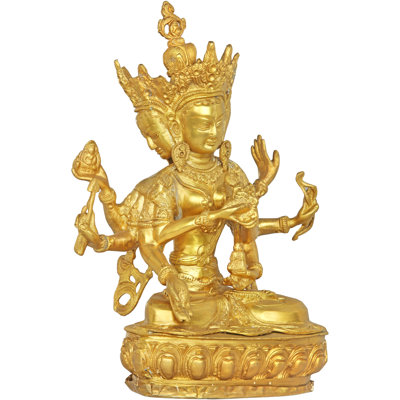
Trimukha Ganapati, the 28th among the 32 distinct forms of Ganapati, stands as a unique and benevolent manifestation of the Lord. With two serene heads cradled on his four divine arms, his presence exudes a sense of grace and power. On one hand, he carries the iconic abhaya mudra, a gesture of fearlessness and protection, while his other arm indulges in the Lord's favorite delight, the modak sweet.Devotees believe that Trimukha Ganapati watches over them and their families, ensuring their well-being and success. When approached with unwavering faith and devotion, this divine form is said to bestow victory and triumph upon his worshipers, guiding them towards success in every endeavor. Discover the divine energy and blessings of Trimukha Ganapati as you invite this auspicious form of Lord Ganesha into your life. His presence is believed to inspire confidence, remove obstacles, and lead you on the path to success.
By Dakota Fields
FREE Delivery
|
"According to Deepak Chopra: "when we choose actions that bring happiness and success to others, the fruit of our karma is happiness and success." By acquainting us with this fact, and establishing it in the very depth of our consciousness, our mother insures our continuous well being. Calmly and serenely poised, the Mother of all presents a picture of reassurance and inspiring confidence. From the delicate fingers of her two hands issue stems terminating into a full blown lotuses. These all associate the Mother Goddess with organic growth and the vegetative principle in nature. Tara is beautiful as all mothers are. Her rich and precious jewelry is as much an acknowledgement of the superior status of the mother in the hierarchy of human relations, as it is of the supremacy of Goddess Tara in the Buddhist pantheon.
