Skip to Main Content
Sign In
Sign In
Religious & Spiritual Statue
30-Day Low Price
Religious & Spiritual Statue

Religious & Spiritual Statue

$5,599.99
{BOLD_AS_LOW_AS}{BOLD_AFFIRM_REUSE_TITLE_SECTION_1}or 0% APR up to 36 months withAffirm
Wayfair Rewards

Earn $280.00 in rewards, with 5% back¹, plus more exclusive perks

Out of Stock
Credit Card

Get $40 off your qualifying first order of $250+** with the Wayfair Credit Card! **

At a Glance

  • Handmade

  • Material: Metal

  • Hand Painted

About This Product

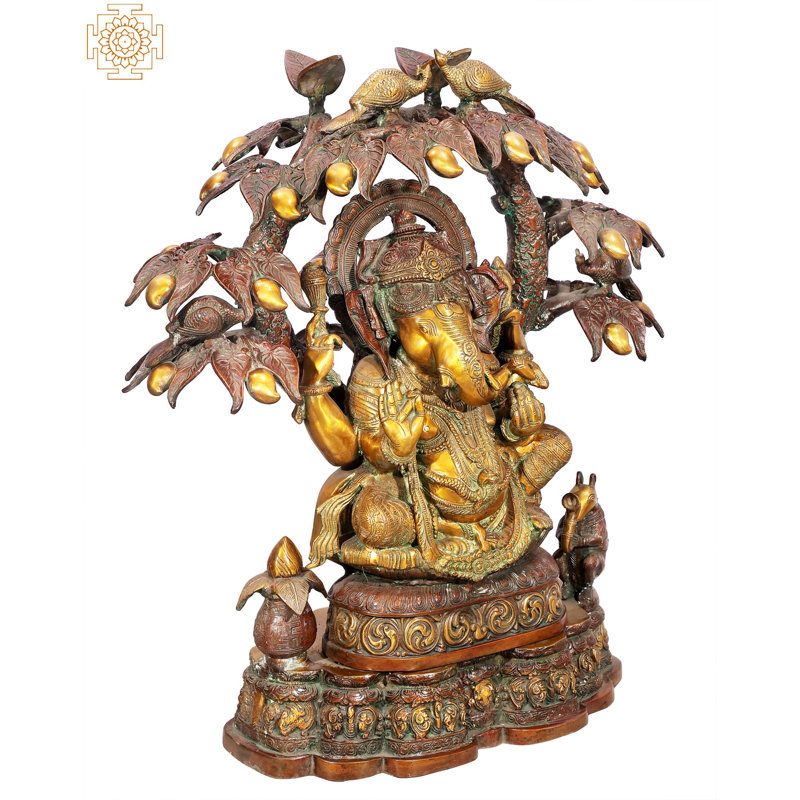
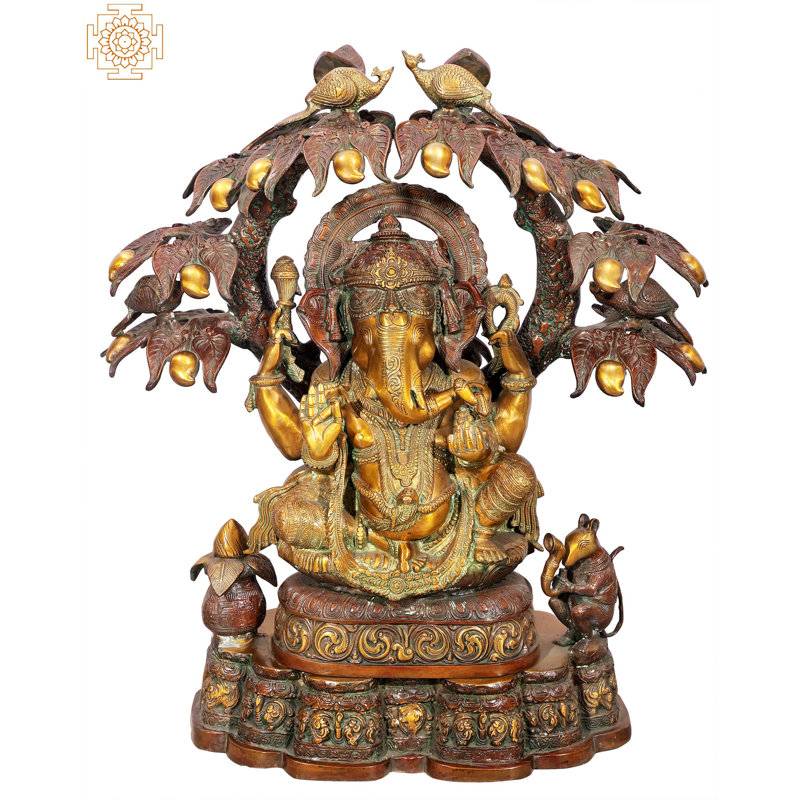
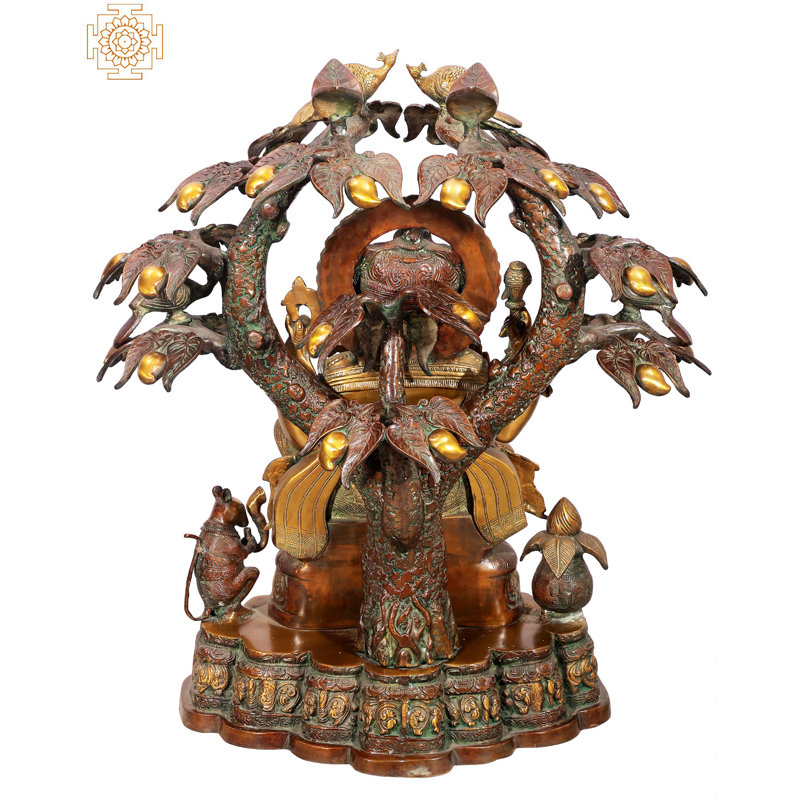
Otherwise a classical form classified in the Ganesha’s iconographic tradition as Vijay-Ganapati – the victorious lord who bestows success on his devotees in all their struggles and efforts, as an art-piece this four-armed image of the elephant god is rare in its aesthetic beauty as well as technical maturity. Highly innovative some of the attributes have been dually used. Vijay Ganapati usually carries a mango in his normal left hand. The artist has replaced it with a custard apple, a new kind of fruit-attribute, and as for a mango has added in the background a mango tree with abundant of mango-fruits on it. The symmetrically rounded branches of the mango tree also serve as fire-arch and larger halo behind the deity image. The deity’s mount mouse has been used, besides as mount, also as the trumpeter lauding his lord by blowing its trumpet. Though a brass-cast for various effects the artifact has been judiciously anodized and shaded using tints of gold, copper and, for a look of antiquity, grayish-green as that of scum on stagnant surface of water. Each tint has been intelligently shaded lest it was monotonous and dominating.

Features

  • For greater precision and finer details all parts of which this statue is composed have been independently cast and then assembled into a comprehensive image. The number of such components is quite large, even the pedestal – seat, the image has been installed on, consists of four parts, the base moulding, middle moulding, ‘purna-ghata – ritual pot, on its right, and the trumpet-blowing mouse – the Lord’s mount, on its left, the top lotus moulding  immediately under the deity, being the fifth. The lotus moulding on the top, Lord Ganesha is seated on, though a pedestal’s part, seems to have been cast with the image proper, that is, with the deity icon itself. At least two of the attributes that the elephant god is holding seem to have been independently cast. Alike the mango tree in the background serving as both, an arch as also the part of the theme, seems have been composed of various units, at least the four peacocks and ten pairs of leaves and mango-fruits, all independently cast and assembled along the tree-branches. Fluted base moulding and the one in the middle have been carved with arabesques breathing an air of rare antiquity.
  • This form of Lord Ganesha closely reflects his manifestation as Vijay Ganapati, one of his 32 classical forms enumerated in the known Mudgal Purana, the earliest treatise on Ganesha theme. As prescribed he is carrying in upper hands elephant goad and noose, while in the normal left, alternating a mango he is carrying a custard apple though this image-form includes a mango as part of the background and thereby of the image, and in the normal right, the broken tusk, the instrument with which he protects his followers. The conqueror and the blissful Lord of victories Vijay Ganapati bestows success and assures achievement of all goals by not allowing obstacles to impede his devotee's path. In obtaining minute details, anatomical proportions, divine aura and classicism the image is outstanding. The elephant god has been represented as seated in ‘utkut akasana’ though it also blends elements of ‘lalitasana’. Instead of both knees lifted, as in ‘utkut akasana’, this posture has right leg horizontally stretched along the floor of the seat as in ‘lalitasana’, while left, lifted as in ‘utkut akasana’.
  • The book associates her with literature and the sciences, and with learning in general. The lute associates her with the arts, particularly the musical arts, and the rosary links her with the spirituality and religious rites. Goddess Saraswati is nearly always dressed in soft colors, reminding us to always utilize our creative energies in a positive and constructive way.