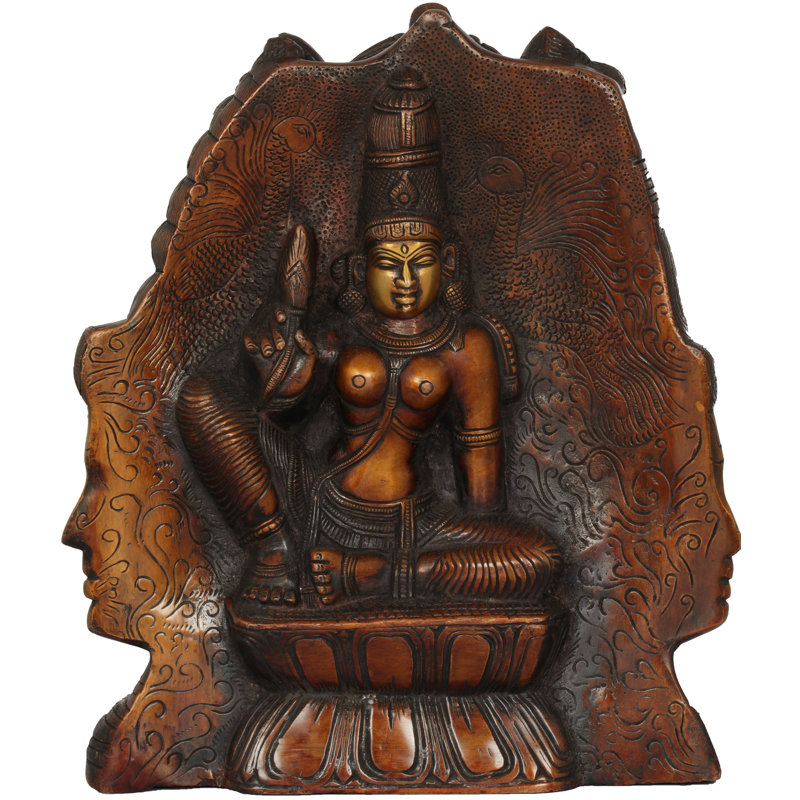
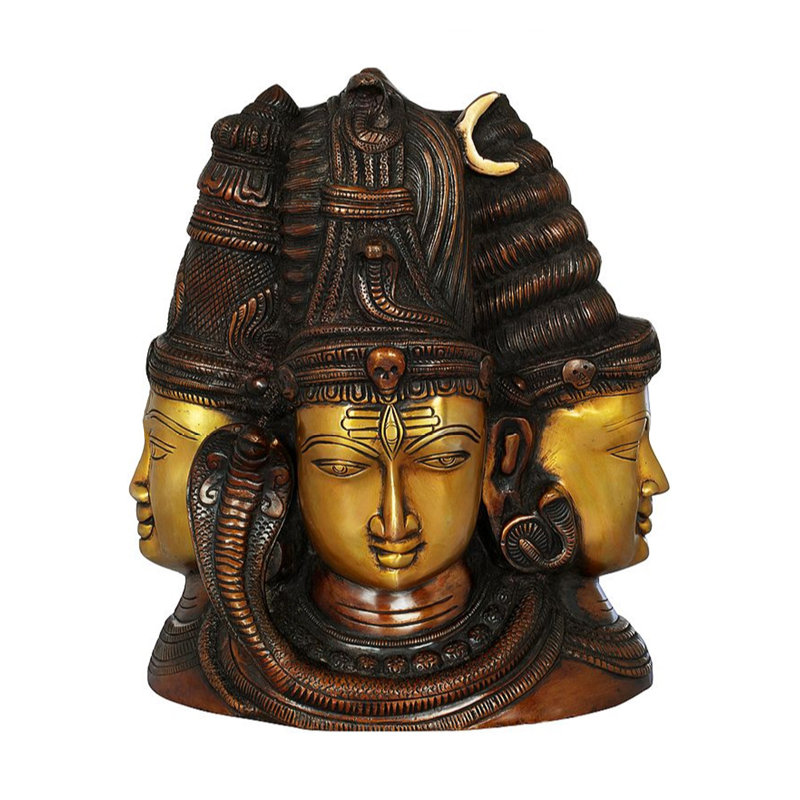
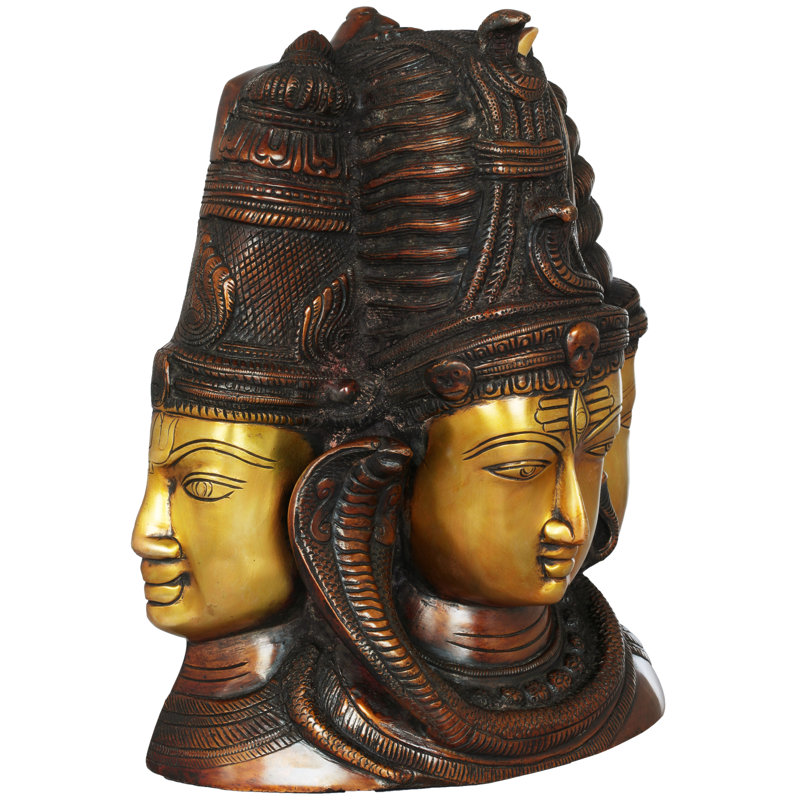
The artist's own vision of Tri-Murti whose ultimate idiom and model has been represented at Elephanta Caves, an island in the Arabian seas locally known as Gharapuri, some eleven kilometers off Mumbai, a territory of Maharashtra, this excellent brass statue rendered using lost wax technique and finely grained brass revealing gold-like luster represents Tri-Murti, the term meaning to popular mind a combined form of three major Hindu gods: Shiva, Vishnu, and Brahma, and scripturally, especially as per Shaivite texts, three forms of shiva, two of which accomplished the functions of Brahma and Vishnu and had their resemblances, and the third, Shivas own. Scripturally, the face on the right is one brimming with youthful vigor and a feminine look representing creation and hence resembling Brahma; in the Shaivite context, Shiva's feminine form, Uma or Vamadeva; that on the left is a terrifying form representing destruction; it represents Shiva in his Aghora, Raudra or Bhairava form; and the face in the center is a pleasant form, resembling Vishnu, and in Shiva's context, Shiva, as Tatapurusha: the Master of positive and negative principles of existence and preserver of their harmony.