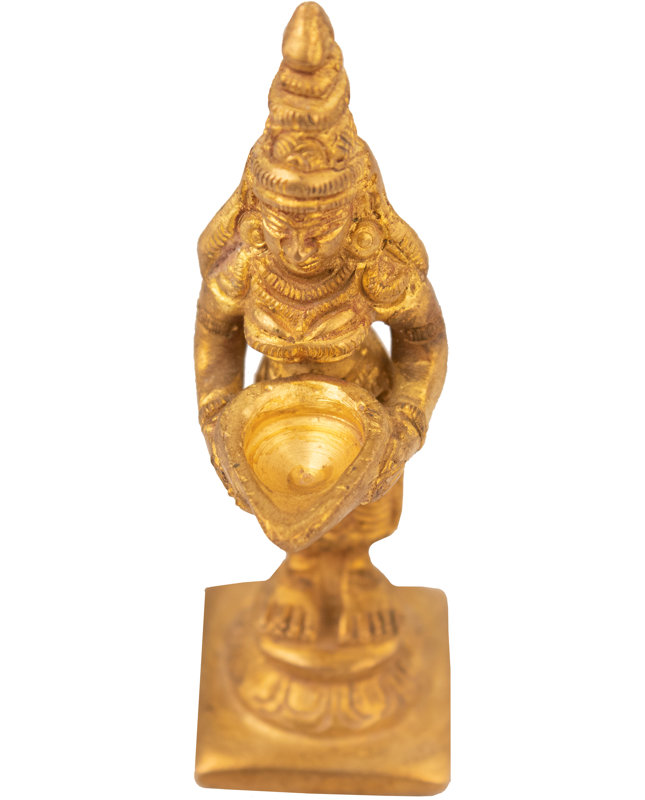
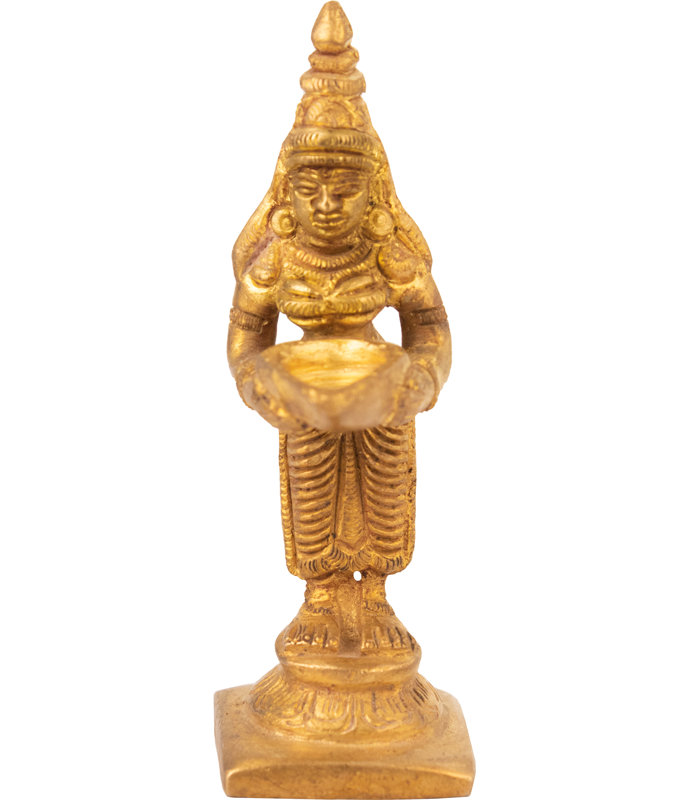
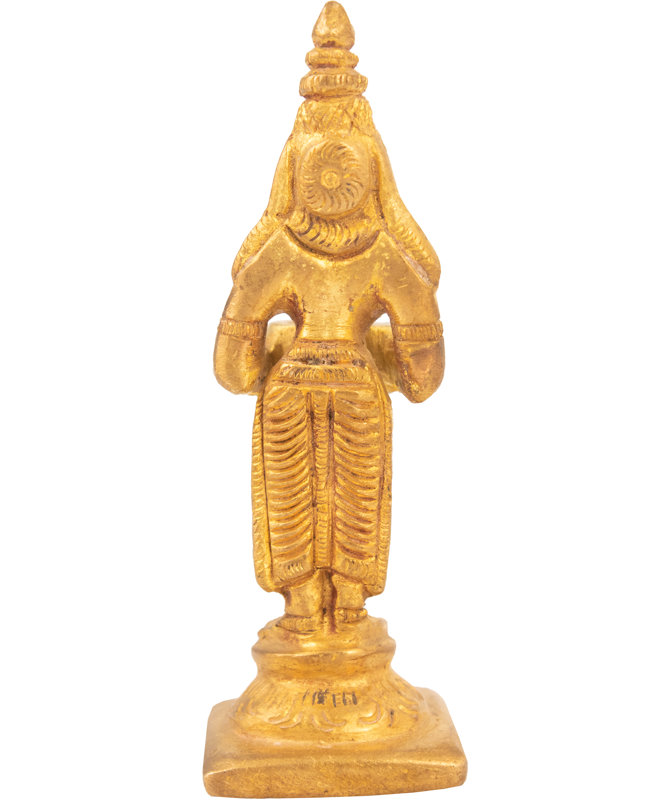
The synchronized movements captured in this brilliant brass with inlay icon carry us to the pages of the 13th-century treatise on dance- Nritta Ratnavali. It mentions Natesh (God of Dance) Shiva teaching Laasya to Parvati. Enthralled by the possibility of being close to Parvati through dance, Shiva asks her to copy his moves. This heavenly togetherness of Shiva-Shakti is revealed here. Poised and graceful, both are completely engrossed in dancing. Parvati, the active female aspect inspires and empowers Shiva to play his damru (drum) whose beats flow through Srishti (creation) whose personification is- Parvati. The slender and glistening limbs of Shiva and Parvati are adorned with beautiful inlay pieces, turning them into divine kaleidoscopes. Turquoise, blue, and red inlay pieces in round and teardrop shapes cover the entirety of the brass Shiva-Parvati statues, providing them with attires befitting for their divine Lila (play). Creepers spring out of the upturned lotus-shaped platform, signaling the germination of life when Purush (Shiva) and Prakriti (Parvati) come together. The style of modeling, jewelry, hairstyle of the subjects, and their meditative expressions suggest that these brass idols are inspired by the sculptural traditions of Nepal, where Shaivism, centered on the reverence of Shiva and Parvati as the manifestation of the supreme consciousness is one of the oldest religious traditions. The Nritta Ratnavali describes this divine dance as an esoteric conversation between Shiva and Parvati, to remain hidden even from their children. Ganesha, the adored younger child is sometimes said to attempt and mimic the moves of his mother, providing parental bliss to Shiva and Parvati with this innocent endeavor. Oh, how similar we are, the children of Shiva and Shakti, looking at the activities of the universe in awe, at the rise and fall of life, whose tangible form is this dancing Shiva-Parvati statue!


 or
or