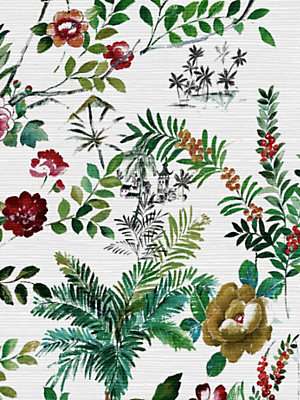
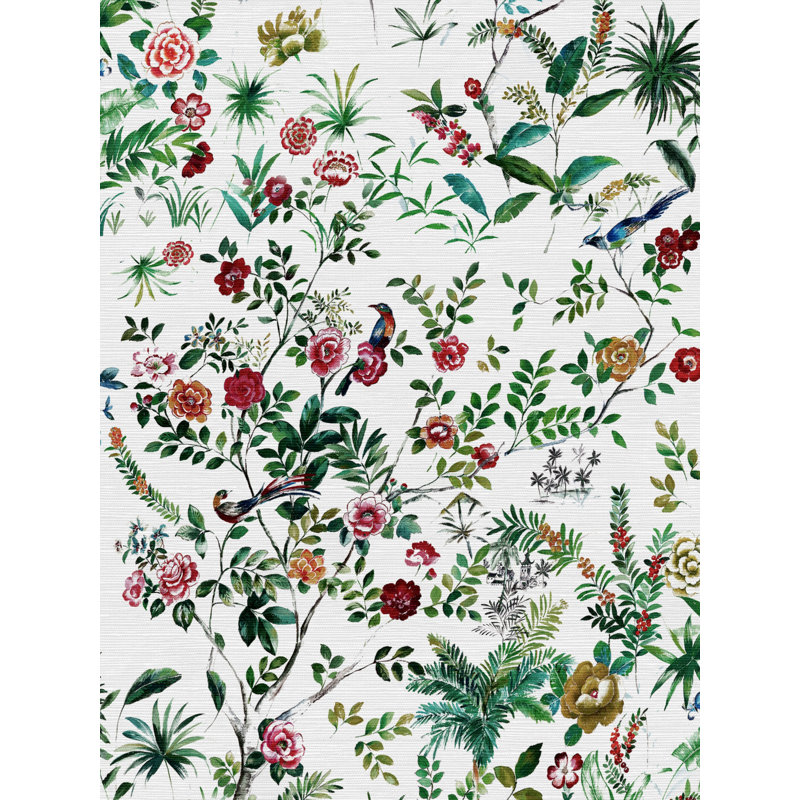
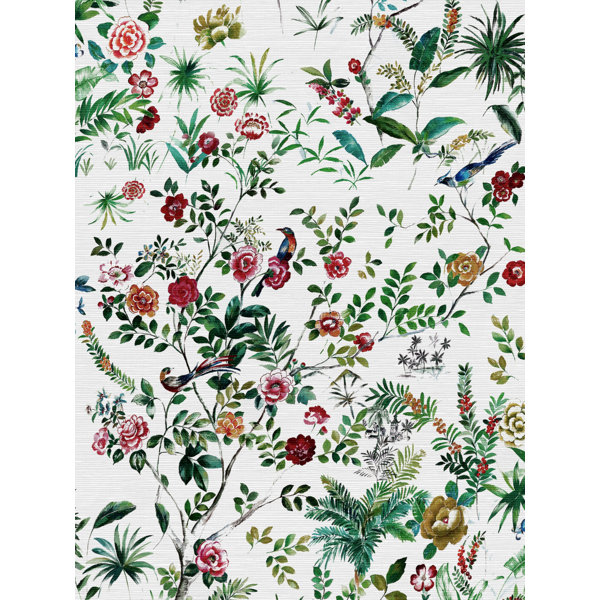
Lost Pavillion Allover features beautiful birds and flowers with a modern nod to the tradition of Chinoiserie that transports one to a rare world of exotic landscape gardens. Lost Pavillion is inspired by the royal palaces of Europe and 18th century great houses in England that were not complete without pagodas in the gardens and chinoiserie paneled walls, garniture sets of Chinese porcelain, lacquer cabinets, and other follies that evoked an European aesthetic and an illusionistic magic involving the European fantasy of the far-east and China. Not at all a cultural appropriation of Chinese culture of its day, it was a decidedly European illusion and subsequent fashion that interpreted Chinese themes in the European style, which then influenced China itself to reimagine itself in the European fantasized eye. The demand for the mixed origin style largely is attributed to the painter Giuseppe Castiglione (Jesuit painter) 1688-1768, who so influenced the Chinese emperor Quianlong that his artistic hybridization between East and West so totally transformed the emperor's and the day's artists, courtiers and culture in China into what we now take as Chinese culture. As an architect, painter and missionary, Castiglione designed and implemented monumental artistic and architectural projects, such as the construction and interior decoration of the European Palaces at the Gardens of Perfect Brightness (Yuan Ming Yuan) in Beijing, which was destroyed by French and British troops in 1860 during the second Opium War.

 or
or