Skip to Main Content
Sign In
Sign In

Wekiva Foliage LLC

1,364 Results

Sort by
Recommended
Silver Yucca - Live Plant in a 3 Gallon Growers Pot - Yucca Rostrata - Rare Outdoor Ornamental Slow Growing Evergreen Tree
30-Day Low Price

Silver Yucca - Live Plant in a 3 Gallon Growers Pot - Yucca Rostrata - Rare Outdoor Ornamental Slow Growing Evergreen Tree

by Wekiva Foliage LLC

$299.99

Rated 4 out of 5 stars.1 total votes

Free shipping

Yucca rostrata, known commonly as Adam's Yucca, Beaked Blue Yucca, Beaked Yucca, Big Bend Yucca, Nordstrom's Yucca, Silver Yucca is a trunk-forming yucca that is native to the Big Bend region of West Texas, Chihuahua and Coahuila, where it grows in desert conditions, where sandy soil and distinct daytime and nighttime temperatures reign. This tree-like yucca is an extremely ornamental, slow-growing evergreen, with a perfectly symmetrical pom-pom-like form. Its form includes hundreds of 2 foot long leaves. The leaves have sharp points and are an attractive pale blue-green color. The rosette of leaves sits at the top of the trunk. The trunk is covered with the remains of old leaves which are soft fibers. Beautiful yellow-orange stalks appear at the top of the plant in late spring. The stalks have clusters of white flowers. This tree-like plant has leaves that are soft, unlike other varieties of yucca, making this a less dangerous plant. One of the hardiest trunk-forming yuccas, it tolerates cold up to zone 5. While full sun is ideal, it tolerates part shade so long as it gets at least three hours of sun. The common name 'Big Bend Yucca' arises from this species being found in its natural habitat of the Big Bend are of the Rio Grand River. Big bend yucca needs to grow in full sun for best results. Place it in a well-lit spot in your backyard. As a winter hardy plant, its suited to USDA Zones 5 through 11. While this yucca tolerates heat with no issues, it will need protection in times with consistent temperatures below -10F (-23C).

    Opens in a new tab
    Hoya Hindu Rope Plant - Live Plant in a 2 Inch Pot - Hoya Carnosa 'Compacta - Indoor Houseplants Straight from The Nursery

    Hoya Hindu Rope Plant - Live Plant in a 2 Inch Pot - Hoya Carnosa 'Compacta - Indoor Houseplants Straight from The Nursery

    by Wekiva Foliage LLC

    $47.99

    Rated 4 out of 5 stars.1 total votes

    Free shipping

    Hoyas have thick, waxy leaves that overflow from a pot in beautiful trailing vines. They bloom in clusters of sweetly smelling flowers like those of their distant cousin, the milkweed. The flowers themselves are dense and waxy, like finely sculpted porcelain, often appearing in pink or white. Native to tropical Asia and Australia, they live a long time and will quickly become some of your favorite houseplants. Hoya prefers either bright indirect light or sunlight for no more than 2 to 6 hours per day. If you choose the sunny option, place your plant on an east- or west-facing windowsill rather than a south-facing one so that it receives rays only during the morning or late afternoon rather than at midday, when direct sun might burn its leaves. During the spring and summer months, water your hoya after the top third or so of its soil has dried out but before the mix is parched all the way downperhaps once per week, but that can vary with conditions. Irrigate it thoroughly enough that water runs from the drainage holes into the plant saucer, then discard the excess. In autumn and winter, cut back the watering to about once every 2 weeks. Some sources recommend 1 month without water during midwinter to spur the plant into blooming in spring. At any rate, never leave the plant sitting in water, such as in a container without drainage holes. It's a great plant to get if you want your house to feel like a jungle with the long vines, but also want extra color and liveliness. A Hoya is a combination between succulents and vining plants like a Pothos or Philodendron in the sense that they look like they're tropical plants, but they actually prefer to dry out, like a succulent.

      Opens in a new tab
      Ficus Alii Standard Tree - Live Plant in a 10 Inch Pot - Ficus Binnendiijkii 'Alii' - Large Ornamental Interior Tree

      Ficus Alii Standard Tree - Live Plant in a 10 Inch Pot - Ficus Binnendiijkii 'Alii' - Large Ornamental Interior Tree

      by Wekiva Foliage LLC

      $264.99

      Free shipping

      The ficus Alii, or Amstel King as it is sometimes called, is a large plant that originally came from Asia, Malaysia, and India. It was first grown commercially in Hawaii where it got the Hawaiian name alii which means king. Although a ficus Alii is closely related to the ficus Benjamina, the Alii variety is much more tolerant and forgiving. The long, narrow leaves are naturally glossy and taper to a point. As this ficus tree grows, it may drop its lower leaves revealing a bare woody trunk, giving this tree a palm-like appearance. Care is easier than for many of its relatives. You'll find it's less temperamental than F. benjamina, that drops its leaves when it doesn't get what it wants. However, leaf drop is possible with 'Alii' if it doesn't get enough light and regular waterings. The Ficus alii standard image that you can see here got its name from its single upright trunk. Its long slender dark green leaves provides an oriental look. This appeal makes it an extremely attractive plant that is appealing both to the interior plantscape industry and to the home market. Moreover, it is believed to have the ability to purify the air. Growth tips are pronounced pink to red that beautifully contrasts against its broad, longer, wider, banana-shaped glossy leaves.

      • Growth tips are pronounced pink to red that beautifully contrasts against its broad, longer, wider, banana-shaped glossy leaves.
      Opens in a new tab

      Clematis Hagley Hybrid - Live Plant in a 4 Inch Growers Pot - Clematis 'Hagley Hybrid' - Starter Plants Ready for The Garden - Beautiful White and Purple Flowering Vine

      by Wekiva Foliage LLC

      $63.99

      Free shipping

      Clematis is a genus of over 250 species, most of which are woody to semi-woody deciduous vines climbing by twining leaf stalks or in some cases trailing over support, but in a few cases grow as freestanding or sprawling herbaceous perennials and small deciduous or evergreen shrubs. Most have flat, cupped or bell-shaped flowers. Some plants feature ornamental fluffy seed heads in autumn. Plants bear opposite, simple to compound leaves which are usually deciduous but sometimes evergreen. Compound leaves range from lobed to trifoliate to biternate to pinnate to bipinnate. 'Hagley Hybrid' features profuse, showy, eight-sepaled, 6-8 diameter, white flowers with purplish brown anthers cover this vine in summer. Bloom on this cultivar comes primarily from the previous year's stems in early summer, but also occurs in a second flush later in the summer on the new (current year's) growth. Clematis can be trained to climb a wall, trellis, fence, arbor, porch, lamppost or other stationary structure. They provides good architectural height and framework for small gardens. They can also be planted to sprawl over and through shrubs, scramble over old stumps or simply as a ground cover in conjunction with other flowering perennials. Containers. Grow in fertile, medium moisture, well-drained soils in full sun to part shade. Vining hybrids are best sited in locations where the flowering parts of the vine are in sun to part shade but the roots are shaded. Some light afternoon shade is usually beneficial in hot and humid summer climates such as the St. Louis area. Clematis vines need a trellis or other support on which to grow.

        Opens in a new tab

        Clematis Comtesse de Bouchard - Live Plant in a 4 Inch Growers Pot - Clematis 'Comtesse de Bouchard' - Starter Plants Ready for The Garden - Beautiful Pink Bloom Flowering Vine

        by Wekiva Foliage LLC

        $63.99

        Free shipping

        A compact woody vine with leathery textured foliage and a profusion of large, brilliant pink blooms with soft yellow centers. A beautiful flowering groundcover or climber for arbors, fences or onto tall shrubs. An excellent choice for small spaces. Deciduous. Place this gracefully flowering vine along on arbor or let it scramble up a nearby broadleaf evergreen shrub or tree where, at eye level, its rose-pink blooms edged in silver can be appreciated. Thrives in well-drained, slightly alkaline soil, with roots sheltered and top growth in the sun. Mulch soil surface to conserve moisture. Water deeply, regularly during first growing season to establish root system; reduce frequency once established. Feed regularly beginning in spring. Remove spent flowers to promote continuous bloom. Clematis is a genus of over 250 species, most of which are woody to semi-woody deciduous vines climbing by twining leaf stalks or in some cases trailing over support, but in a few cases grow as freestanding or sprawling herbaceous perennials and small deciduous or evergreen shrubs. 'Comtesse de Bouchaud' is a large-flowering, hybrid clematis cultivar featuring profuse, 4-6 across, rose pink flowers with creamy yellow stamens. Bloom comes from the current season's growth and appears in a long, continuous summer display. One of the most popular of the pink clematis.

          Opens in a new tab
          30-Day Low Price
          Available in 4 Sizes

          Clematis Silver Moon - 3 Live Starter Plants in 2 Inch Growers Pots - Starter Plants Ready for The Garden - Rare Clematis for Collectors

          by Wekiva Foliage LLC

          3
          $109.99

          Free shipping

          There are more than 300 species and hundreds of hybrids of clematis. Most clematis are woody, deciduous vines while others are shrub, or trailing types. Some species bloom in spring; others, in mid-to late summer. Most clematis are hardy in USDA Hardiness Zones 4 to 8 and native to North America. The blooms are spectacular with some flowers reaching up to 10 inches across! These showy flowers in the form of saucers, bells, tubes, tulips, open bells, doubles, and semi-double. The flowers are usually in the cool shades of purple or pink though they do come in a stunning array of tones including blue, white, magenta, yellow, and bicolor. Clematises appreciate a trellis, post, or stationary structure to climb; without something, the vine will sprawl, including over the ground. Hummingbirds, bees, and butterflies love their blooms. Grow in fertile, medium moisture, well-drained soils in full sun to part shade. Vining hybrids are best sited in locations where the flowering parts of the vine are in sun to part shade but the roots are shaded. Some light afternoon shade is usually beneficial in hot and humid summer climates. Roots should be kept cool, shaded and uniformly moist. Root areas may be shaded with perennials, annuals or small shrubs. A thick root mulch is appreciated. Do not allow soils to dry out.

            Opens in a new tab
            30-Day Low Price
            Available in 4 Sizes

            Clematis Crystal Fountain - 3 Live Starter Plants in 2 Inch Growers Pots - Starter Plants Ready for The Garden - Rare Clematis for Collectors

            by Wekiva Foliage LLC

            4
            $125.99

            Free shipping

            There are more than 300 species and hundreds of hybrids of clematis. Most clematis are woody, deciduous vines while others are shrub, or trailing types. Some species bloom in spring; others, in mid-to late summer. Most clematis are hardy in USDA Hardiness Zones 4 to 8 and native to North America. The blooms are spectacular with some flowers reaching up to 10 inches across! These showy flowers in the form of saucers, bells, tubes, tulips, open bells, doubles, and semi-double. The flowers are usually in the cool shades of purple or pink though they do come in a stunning array of tones including blue, white, magenta, yellow, and bicolor. Clematises appreciate a trellis, post, or stationary structure to climb; without something, the vine will sprawl, including over the ground. Hummingbirds, bees, and butterflies love their blooms. Grow in fertile, medium moisture, well-drained soils in full sun to part shade. Vining hybrids are best sited in locations where the flowering parts of the vine are in sun to part shade but the roots are shaded. Some light afternoon shade is usually beneficial in hot and humid summer climates. Roots should be kept cool, shaded and uniformly moist. Root areas may be shaded with perennials, annuals or small shrubs. A thick root mulch is appreciated. Do not allow soils to dry out.

              Opens in a new tab
              Available in 2 Sizes

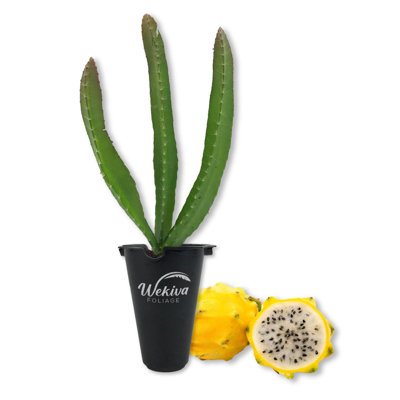
              Yellow Dragon Fruit Tree - Live Tree in a 3 Gallon Pot - Selenicereus Megalanthus - Edible Tropical Fruit Plant from Florida

              by Wekiva Foliage LLC

              13" H x 4" W x 4" D
              $56.99

              Free shipping

              Dragon fruit is a fruit with tiny black seeds and vibrant pink skin. Each fruit weighs between 150-600g and is commonly used in fruit salads, smoothies and salads. It has little flavour and its texture closely resembles that of kiwi fruit. To prepare all you to do is to cut the fruit in half and then scoop out the flesh. dragon fruit is native to South America, but youll also found it grown in parts of Indonesia, Taiwan, Southern California and most recently Australia. Dragon fruit grows on cactus plants which love warm, humid climates and needs very little water. They are subtropical plants which need at least six hours of sunlight per day. They will also grow well in a warm and sunny spot indoors. In the right conditions dragon fruit plants grow can grow to be quite tall and will put down aerial roots as they grow so make sure your pot is at least 40cm in diameter. Also, remember that dragon fruit plants are climbers so give them a stake or something else to climb on. Growing dragon fruit outdoors in your garden is a fail-proof way to add colour and personality to your garden. To prepare simply clear the area of any weeds and rocks and make sure that the soil is slightly sandy and acidic, you can always add a bit of extra potting mix to the bed to help make it cacti-proof. When your dragon fruit starts flowering is a good indicator that fruit is on its way. Generally speaking, it will take around four weeks for a dragon fruit to be ready, youll know when it is ripe when its skin turns that vibrant pink. Use a pair of sharp secateurs to cut the fruit off and store it in the fridge for up to two weeks.

                Opens in a new tab

                Tradescantia Nanouk Wandering Jew - Live Plant in a 2 Inch Pot - Tradescantia Albiflora 'Nanouk' - Rare and Elegant Indoor Houseplant

                by Wekiva Foliage LLC

                $48.99

                Free shipping

                Tradescantia plants are much loved for their variegated leaves, deep purple color (although there are also green varieties!) and for how extremely easy they are to propagate. Tradescantia. make a lovely, understated statement in outdoor garden beds or planters, and are perhaps even more striking indoors when allowed to trail in hanging baskets. The Tradescantia is a pretty, trailing plant that goes by common names like Wandering Jew, Wandering Dude, Spiderwort, and Inch plant. Tradescantias are native to the Americas from southern Canada down to South America. They like bright, indirect light, moist soil, and high humidity. Tradescantia likes bright, indirect light. They need a good amount of light; if they dont get it, youll notice that their leaf markings begin to fade. Direct sun, however, will scorch their leaves (with the exception being the purple queen variety, which loves full sun). Tradescantia loves moisture. Dont ever let your plant get too dry, especially in winter. To keep soil evenly moist, a regular watering schedule is best. Water until water drains through the bottom of the pot, taking care that your plant wont sit in water.

                • The Tradescantia is a pretty, trailing plant that goes by common names like Wandering Jew, Wandering Dude, Spiderwort, and Inch plant.
                • Tradescantias are native to the Americas from southern Canada down to South America. They like bright, indirect light, moist soil, and high humidity.
                Opens in a new tab

                English Ivy Heart - Live Plant in a 6 Inch Pot - Hedera Helix - Florist Quality Beautiful Easy Care Indoor Air Purifying Topiary Houseplant Vine

                by Wekiva Foliage LLC

                $132.99

                Free shipping

                English ivy (Hedera helix) is an evergreen perennial. It is also classified as a woody vine. English ivy can act as a ground cover, spreading horizontally and reaching 8 inches in height. But it is also a climber, due to its aerial rootlets, which allows it to climb to 80 feet high. The plant will eventually bear insignificant greenish flowers, but it is grown primarily for its evergreen leaves. In this regard, ivy can be classified as a foliage plant. The best time to plant English ivy is spring. English ivy plants grow well in part shade to full shade. The ability to grow in shade has made English ivy a traditional ground cover for planting under trees, where most grasses may not grow well. Since ivy is vigorous and has a dense growth habit, it's an effective ground cover if your objective is to crowd out weeds. Grow this evergreen vine in well-drained soil. Although it will grow in poor soils and soils of a wide range of pH levels, it does best in average loams. A thick layer of mulch helps keep the soil moist in dry climates. When watering your ivy, always check the soil before adding water. Ivies prefer to be kept slightly on the dry side, so let the soil dry out some (dry to the touch on top) before you water your ivy plants again. Indoor or outdoor ivy prefers evenly moist, but not soggy soil.

                  Opens in a new tab
                  Sale
                  Available in 3 Sizes

                  Clematis Elsa Spath - Live Starter Plants in 2 Inch Growers Pots - Starter Plants Ready for The Garden - Beautiful Dark Lavender Flowering Vine

                  by Wekiva Foliage LLC

                  4
                  $118.99

                  Free shipping

                  A beautiful, reliable selection that produces a profusion of blue flowers with lavender tones. A good choice for training on walls, arbors, or growing through medium to tall shrubs. Deciduous. Follow a regular watering schedule during the first growing season to establish a deep extensive root system. Provide the support of a trellis or arbor. Roots prefer a cool, shaded area, tops in the sun. Elsa Spath Clematis features showy lilac purple star-shaped flowers with yellow eyes at the ends of the branches from early to late summer. It has green foliage throughout the season. The compound leaves do not develop any appreciable fall color. The fruit is not ornamentally significant. Elsa Spath Clematis is a multi-stemmed deciduous woody vine with a twining and trailing habit of growth. Its average texture blends into the landscape, but can be balanced by one or two finer or coarser trees or shrubs for an effective composition. This is a relatively low maintenance woody vine. It is a Type 2 clematis, which means it will bloom primarily on old wood of the previous season, with a second flush later in summer. Dead and weak vines should be removed in late winter, and remaining vines should be trimmed back to the first buds that are seen to remove dead stems. It is a good choice for attracting hummingbirds to your yard. It has no significant negative characteristics.

                    Opens in a new tab

                    Devil's Backbone - Live Plant in a 4 Inch Pot - Pedilanthus Tithymaloides - Rare Cactus Succulent from Florida

                    by Wekiva Foliage LLC

                    $63.99

                    Free shipping

                    Devils backbone (scientific name Euphorbia tithymaloides or Pedilanthus tithymaloides) is a succulent plant that also goes by Jacob's ladder, Japanese poinsettia, Persian lady slipper plant, and zig-zag plant. The tropical plant is native to Central America and Mexico. Delightfully crooked, zig-zag stems give Variegated Devils Backbone its wild, rebellious look and playful nickname. Variegation in shades of chartreuse, yellow and cream highlight the edges of the small, pointed leaves, adding extra appeal to its exotic form. In the cooler winter months, the leaf edges can take on a pink hue. Variegated devils backbone grows well in well-drained soil of nearly any texture when planted outdoors. Plant your indoor slipper plant in an all-purpose potting soil mixed with coarse sand, with a 6.1 to 7.8 pH level, for optimal results. Keep the soil barely moist from tepid water, and protect your plant from temperatures below 50 degrees Fahrenheit. The plant will perform best in Sunset Zones H1, H2, 22, 23 and 24. Your devils backbone will thrive best in bright, but indirect, sun, although it will also tolerate partial shade. This colorful, succulent shrub makes a uniquely sculptural houseplant specimen. Also called Jacobs Ladder, or Redbird Flower, the plant can develop tiny red flowers on the growing tips in spring, however they often dont bloom in cultivation.

                      Opens in a new tab
                      30-Day Low Price

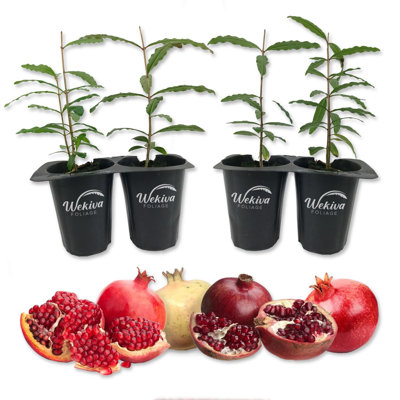
                      Pomegranate Tree - Live Plant in a 3 Gallon Pot - 3-5 Feet Tall - Edible Fruit Bearing for The Patio or Garden

                      by Wekiva Foliage LLC

                      $247.99$305.99

                      Free shipping

                      Once considered a fruit for royalty, the pomegranate is a delicious addition to your backyard orchard or edible landscaping. Its beautiful, showy, red-orange flowers become decorative fruit in the fall. Best known for the antioxidant-rich fruit it produces, the pomegranate shrub is widely grown throughout the Mediterranean region. Its tubular blooms begin to appear in late May and early June, providing nice spring color, while the fruit ripens from September to October. The fruit is a bit unusual, as the only edible parts are the jewel-like arils and seeds found inside. The pomegranate fruit is a leathery skinned red sphere known as an aril. The thick aril contains several hundred juicy red edible fruits that are similar to berries. They are known for their antioxidant properties and many associated health benefits. The pomegranate tree will adapt to either acidic or alkaline soil, though it prefers something in the range of 5 to 7 pH. Add plenty of organic well-rotted compost to your soil, as this will both improve drainage and also improve the quality of the soil, providing much-needed nutrients to the pomegranate tree. The pomegranate tree is drougt tolerant and can be grown in a dry area and in areas where there is good rainfail. It is best not to plant in wet areas as they are prone to root decay for fungal diseases. They also tolerate dipping temperatuares down to about 10 degrees but should be planted in an area of protection from direct winter winds.

                        Opens in a new tab

                        Fignomenal Fig Tree - 3 Live Starter Plants in Grower's Liners - Ficus Carica - Edible Fruit Tree for the Patio and Garden

                        by Wekiva Foliage LLC

                        $54.99

                        Free shipping

                        The Fig Tree (Ficus Carica) is a stunning and productive addition to any home garden, offering lush, broad leaves and deliciously sweet fruit. Native to the Mediterranean and western Asia, this deciduous tree is renowned for its resilience and adaptability, thriving in a variety of climates. During the growing season, the fig tree produces attractive green foliage that provides excellent shade, creating a lush and inviting outdoor space. As it matures, it develops a graceful, spreading canopy and distinctive smooth gray bark, enhancing the aesthetic appeal of any landscape. One of the most rewarding aspects of growing a fig tree is its bountiful fruit production. The tree yields plump, teardrop-shaped figs that ripen to shades of deep purple, brown, or green, depending on the variety. The fruit is not only flavorful but also highly versatile, making it a favorite for fresh eating, drying, or culinary use in a variety of dishes. Figs are known for their soft, sweet flesh with subtle floral notes, offering a delightful treat straight from the garden. The fig tree is a fast-growing species that can reach heights of 10 to 30 feet, though it can also be pruned to maintain a more compact size, making it suitable for small gardens or container growing. It thrives in warm, sunny conditions and is well-suited to Mediterranean, subtropical, and temperate climates. With proper care, this tree can provide an abundance of fruit for many years, making it a fantastic investment for both novice and experienced gardeners.

                          Opens in a new tab
                          Available in 4 Sizes

                          Clematis The President - Live Starter Plants in 2 Inch Growers Pots - Starter Plants Ready for The Garden - Rare Clematis for Collectors

                          by Wekiva Foliage LLC

                          4
                          $119.99

                          Free shipping

                          There are more than 300 species and hundreds of hybrids of clematis. Most clematis are woody, deciduous vines while others are shrub, or trailing types. Some species bloom in spring; others, in mid-to late summer. Most clematis are hardy in USDA Hardiness Zones 4 to 8 and native to North America. The blooms are spectacular with some flowers reaching up to 10 inches across! These showy flowers in the form of saucers, bells, tubes, tulips, open bells, doubles, and semi-double. The flowers are usually in the cool shades of purple or pink though they do come in a stunning array of tones including blue, white, magenta, yellow, and bicolor. Clematises appreciate a trellis, post, or stationary structure to climb; without something, the vine will sprawl, including over the ground. Hummingbirds, bees, and butterflies love their blooms. Grow in fertile, medium moisture, well-drained soils in full sun to part shade. Vining hybrids are best sited in locations where the flowering parts of the vine are in sun to part shade but the roots are shaded. Some light afternoon shade is usually beneficial in hot and humid summer climates. Roots should be kept cool, shaded and uniformly moist. Root areas may be shaded with perennials, annuals or small shrubs. A thick root mulch is appreciated. Do not allow soils to dry out.

                            Opens in a new tab
                            30-Day Low Price

                            Tamarind Tree - Sampaloc - Live Plant in a 1 Gallon Growers Pot - Tamarindus Indica - Beautiful Edible Fruit Bearing Tree for Patio and Garden

                            by Wekiva Foliage LLC

                            $136.99

                            Free shipping

                            The Tamarind Tree (Tamarindus Indica) also known as the Sampaloc Tree, is a tropical, evergreen tree native to Africa, renowned for its sweet and tangy fruit. This tree can grow up to 80 feet tall, featuring a dense canopy of feathery, bright green foliage that provides ample shade. Its unique, pod-like fruits contain a sour pulp used in culinary dishes across the world. The tamarind tree is highly adaptable and can thrive in a variety of environments, making it an excellent addition to both ornamental and functional gardens. It is known for its ability to withstand drought once established, making it a low-maintenance option for those living in hot, dry climates. Besides its culinary uses, tamarind pulp is also used in traditional medicine for its digestive benefits. As the tree matures, it produces a fragrant yellowish-white flower that later gives way to the distinctive brown pods. Tamarind trees are a popular choice for backyard orchards or large estates due to their attractive, spreading shape and the fact that they provide fruit over several months. They are especially beloved in tropical regions but can also be grown in subtropical and warm temperate areas. The tree is ideal for growing in well-drained soil and thrives with a lot of sunlight. It requires minimal care once established, making it a perfect choice for beginners who want to grow a productive fruit tree.

                              Opens in a new tab
                              ServerT:3.1361699104309