Dutch Oven vs. Slow Cooker: Which One Do You Need?
To choose between a Dutch oven vs. slow cooker, take time to understand the differences.
Trying to decide whether a Dutch oven vs. slow cooker will better meet your needs in the kitchen? Each of these classic kitchen tools can help you cook tasty meals, but if you only want one, the best choice will depend on your schedule and cooking style. Read on to learn more.
What Is a Dutch Oven vs. Slow Cooker ?
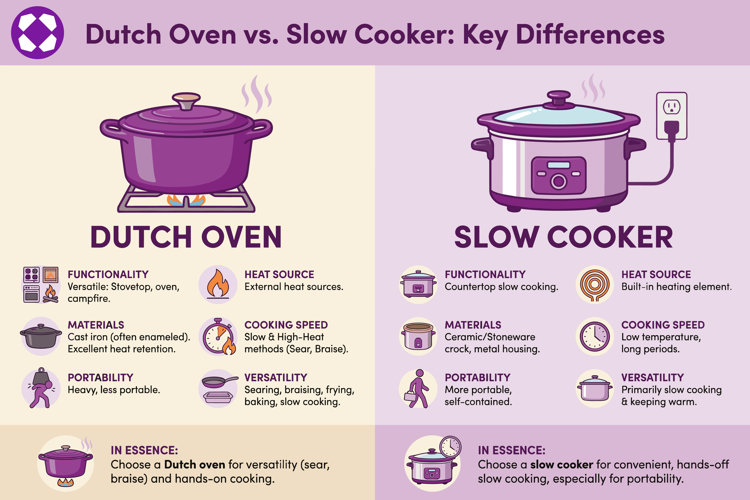
- Slow Cooker:A slow cooker is used to simmer slowly at low temperatures, as compared to baking, boiling, roasting or frying. The slow cooker includes a crock, or ceramic bowl, on the inside, which keeps heat in and allows food to cook slowly and evenly. The crock fits into a metal base with a heating element, which sends heat up the sides of the crock when you plug it in and turn it on. Most slow cookers have two settings, high or low, and some have a third setting to keep food warm after cooking. When comparing a Dutch oven vs. slow cooker, the main differences are the slow cooker's lower temperature and longer cooking time.
- Dutch Oven: A Dutch oven, on the other hand, is a cooking pot with thick walls and a tight-fitting lid. It is usually made of cast iron, but some are made of cast aluminum or ceramic. Dutch ovens are sometimes called multi-cookers because you can use them to cook in a variety of ways, including roasting, baking, browning, searing, frying, broiling, stewing and steaming. In comparing Dutch ovens vs. crock pots, Dutch ovens require you to be involved during the cooking process – but by doing so, you can create a wide variety of delicious meals. To learn more about Dutch ovens, read our guide What Is a Dutch Oven?.
Slow cookers save time. They are ideal when you don't have time to stand over the stove for an hour or longer, and unlike a Dutch oven, they make it possible to cook a meal when you're not even home. Take a look at some of the features choosing a slow cooker over a Dutch oven will get you.
- Adjustable Temperature Settings: Slow cookers with adjustable temperature settings allow you to program different heat settings and time durations in one cooking cycle.
- Keep Warm Setting: With a "keep warm" setting, you can keep the food warm in your slow cooker after completing the cooking cycle.
- Timer:When you have a timer on your slow cooker, you can set it to stop cooking even if you'll be away from home longer than your dish needs to cook.
- Auto Shut-Off: An automatic shut-off feature will automatically turn your slow cooker to the "warm" setting when it completes the cooking cycle.
- Programmable:With a programmable slow cooker, you can program cook times so your food will start cooking at the right time and will cook for the appropriate length of time.
- Delay Start Setting: If you'll be gone for ten hours and you want your food to cook for five hours before you get home, you can use the delay start setting to make it start cooking at the right time. This flexibility is one feature that sets slow cookers apart from Dutch ovens.
- Removable Interior:Slow cookers with a removable interior pot simplify the clean-up process.
Also, slow cookers come in various sizes so you can choose the one that best meets your needs. If you usually cook for one or two, you can get a single-portion slow cooker or a 4- or 5-quart slow cooker. If you'll be cooking for a crowd, you can get a larger, 7-quart or 8-quart cooker.
If you want to cook multiple dishes in a slow cooker, you can even get crock pots with double or triple crocks.
Dutch ovens are extremely versatile. Because they can perform many different types of cooking, they can produce all kinds of foods, including stews, sauces, soups, casseroles, whole chickens, and even some types of bread. Take a look at some of the features you'll get when choosing a Dutch oven vs. slow cooker.
- Oven-Safe: Unlike a slow cooker, you can use a Dutch oven on the stovetop, over a campfire, and even in the oven. If you plan to use your Dutch oven in the oven, make sure to purchase one that is oven-safe and can handle high temperatures.
- Nonstick: A nonstick Dutch oven can simplify clean-up and ensure that your food never gets stuck to the bottom of the pan. However, even nonstick Dutch ovens can stick if you cook on too high heat.
- Cool-Touch Handles: Choose a Dutch oven with cool-touch handles and protect your hands from being burned during the cooking process.
Selecting a Dutch oven vs. slow cooker depends on your particular cooking needs and the time you have available to stand over the meal you're cooking. If you prefer a hands-off approach and a variety of tech settings, choose a slow cooker. If you prefer an active cooking experience or want to cook versatile dishes, choose a Dutch oven.
Written by Nancy Mann Jackson
