Bathroom Layout Dimensions: Your Guide to Bathroom Space-Planning
Maximize your bathroom.
Whether you are renovating a bathroom or designing one from scratch, understanding recommended bathroom layout dimensions and space planning can help you create a bathroom that is comfortable and functional. Keep reading to learn more.
In this guide:
Bathroom Layout Guidelines & Guidelines
Bathroom Fixture Dimensions
Frequently Asked Questions
Key Takeaways
- Follow the 30" Rule: Maintain at least 30" of clearance in front of each main bathroom fixture for a comfortable setup and enhanced safety.
- Use Standard Fixture Spacing: Leaving 15" of space from the center of the toilet and 24" in front of shower or bathtubs can prevent overcrowding.
- Consider Obstructions: Make sure to include door swing, open drawers, and windows while planning the layout of your bathroom.
Bathroom Layout Dimensions & Guidelines
Before installing your bathroom fixtures, keep this general tip in mind: big fixtures, such as toilets, bathtubs, showers, and vanities, should be placed at least 30" apart from each other, a wall, or another feature. For more specific bathroom layout ideas regarding clearance and placement recommendations, read below.
Toilet
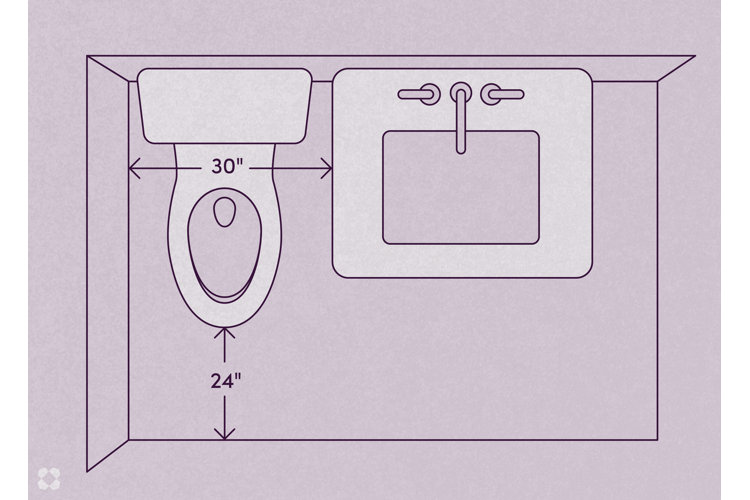
Clearance: Leave at least 21" of space in front of the toilet.
Placement: Leave at least 15" of space from the center of the toilet to a wall or another object. To ensure privacy, install a toilet out of direct sight – off to one side of the doorway or hidden behind the vanity.
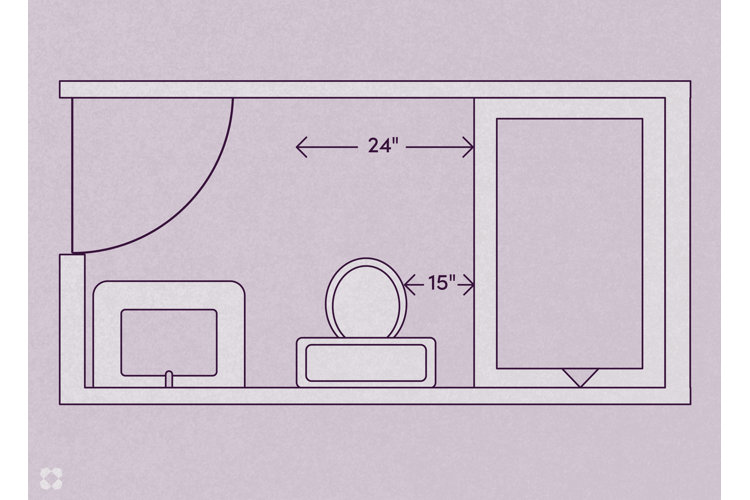
Clearance: At least 24" of space is needed in front of a shower or tub entry. Leave at least 15" of space between the shower and toilet or other obstacle. If you have a swinging door, take into consideration nearby fixtures. To prevent a collision, consider the placement of hardware including towel bars, handlebars, and light fixtures.
Placement: If your bathroom has a decent amount of open space, you can consider installing a stylish freestanding bathtub. If your bathroom's space is limited, a shower can be installed against a wall, in a corner, or in an alcove to conserve as much floor space as possible.
Clearance: Provide at least 30" in front of the vanity. However, for more space, we recommended 42".
Placement: The suggested distance from the center of a sink to a wall or another obstacle is no less than 20". It is recommended to have at least 15" between the center of the sink and a back wall. Keep in mind a vanity must have an electrical outlet installed within 36" of one side of the vanity and out of range with the tub or shower.
Clearance: Hang fixtures at least 8' above a tub and at least 3' from the tub's rim.
Placement: Bathroom lighting should be limited to the ceiling and walls. Corded light fixtures are unwise given the chance that they might get wet. Bathrooms are usually the most damp and wet places in the home, so make sure the light fixtures you choose to install in a tub or shower space are suitable for this room.
For proper bathroom ventilation, a window has to be at least 3 sq. ft. and it needs to open at least halfway. If you don't have windows, install an exhaust fan. They are available with (for an all-in-one solution) or without lights.
A bathroom door must be at least 32" wide to accommodate a person in a wheelchair. There should be at least 2.5' x 4' (10 sq. ft.) of open floor space available. A circle of floor space with a diameter of 5' is required for a wheelchair to be able to rotate. In order for a wheelchair-bound person to be able to reach and comfortably use the sink, the sink should be no higher than 34", with at least 29" of open space beneath the basin and no more than 2" of rim or counter space. We recommend pedestal sinks with a narrow base or a wide console sink. The seat of the toilet must be between 17" – 19" off of the floor and the flush handle should be easy to access. We recommend standard height toilets as the seat is 17" off the floor or lower. Showers must have safety bars. A safety bar should be installed beside the toilet as well.
When planning a bathroom layout, it's also important to consider how bathroom fixtures will fit in the space. Overall, you want a well-planned bathroom where you can move about with ease from one task to the next. Here are some important fixture dimensions to be aware of:
Toilet Measurements
A standard toilet is typically 27" – 32" tall with a seat height of 15" – 17". Standard toilet width is 20" and standard toilet depth is 28" – 30". Wall-mounted toilets tend to be 18" – 22" tall with a seat height of 15" – 19", a width of about 14", and a depth of about 21". They conserve the most floor space possible. For a more detailed look at the dimensions of different toilets, check out our Toilet Dimensions and Measurements guide.
Shower & Bathtub Measurements
The interior of a standing shower is typically 36" x 36", 36" x 42", or 36" x 48". A standard bathtub is 60" long and 32" – 41" wide.
Vanity & Sink Measurements
Bathroom vanities are typically 32" – 36" tall, 20" – 21" deep, and between 24" and 72" wide. Single sink vanities are between 24" and 48" wide and double sink vanities tend to be 60" or 72" wide. Freestanding sink styles, like wall-mount, pedestal, and console styles tend to be 32" – 38" tall, 8" – 15" deep (front to back), and 12" – 18" wide.
Tip!
For small bathrooms, opt for a pedestal sink with a medicine cabinet over a standard vanity. It offers more floor space and brings an open feel to the room.
Vanity Mirror Measurements
Vanity mirrors should be proportional in size to the vanity or sink below. As a rule of thumb, the mirror should be 70% – 80% the width of the vanity. For example, pair 36" vanity with a vanity mirror that is 30" – 34" wide. When hanging the vanity mirror, place it 6" – 8" above the faucet to avoid splashes and provide a comfortable eye-level height for getting ready.
Frequently Asked Questions
How much space do you need in front of a toilet?
At least 30" in front and 15" from the side wall is recommended.
How wide should a bathroom walkway be?
Walkways should be at least 30" wide for comfort and accessibility.
What is the minimum space in front of a shower?
Leave 24" in front of the shower entry.
How much space is required in front of a bathtub?
Allow 24" in front of a bathtub for safe entry and exit.
More Resources
- To get more information on standard bathroom sizes, check out our guide Standard Bathroom Sizes.
- For several visuals depicting bathroom layout ideas, check out our guide Bathroom Layout Ideas & Floor Plans.
- For even more information, check out our Planning a Bathroom Remodel and How Much Does a Bathroom Remodel Cost? articles.
