Lighting an Office: Your How-To Guide
These office lighting tips are illuminating.
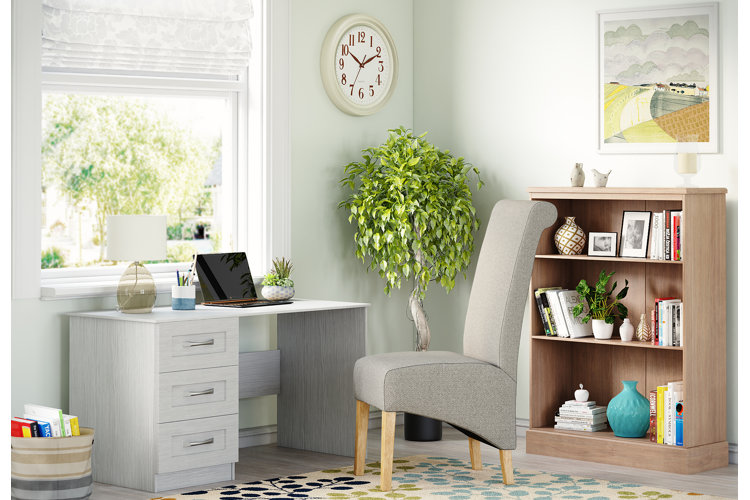
Having a comfortable and conducive workspace is important for both your productivity and your health. That's why you should learn the best strategies for lighting an office. The right lighting should be high on your office design priority list, right up there with a comfortable chair and pleasing decor.
After all, poor lighting can cause you to strain your eyes, cause headaches, and impact your overall energy and mood.
From how to position your desk to the types of lamps and lights you should use, these office lighting tips will brighten your work day.
Types of Office Lighting
Before diving in, you should know the three main types of lighting you usually find in a home office:
Ambient Lighting: An indirect, main lighting source in the room, usually from overhead fixtures like chandeliers, fluorescents, or recessed lighting. It can also come from large floor lamps.
Task Lighting: Direct lighting that can be focused on one area. For a home office, task lighting is usually a desk lamp or a floor reading lamp.
Natural Light: If you have windows or a skylight, then you have natural sunlight coming in from outside.
Finding the right balance of these three types of office lighting is key.
1. Think About Your Layout
According to the Occupational Safety and Health Administration (OSHA), learning how to position your desk, especially when you work on a computer, is very important. That's because bright lighting overhead or light streaming in from a window can cause glare when looking at your screen, or it could cause “wash out," which also makes your screen difficult to see.
The best way to combat that is to set up your desk so that your computer is not directly under an overhead lighting source, or directly in front of a window. Instead, place your desk perpendicular to your window, and off to the side of hanging lighting fixtures. Track lighting can be a good choice in a home office since you can pivot and point them whichever way you'd like. Wall sconces can also work well since they won't directly shine on our desk.
Another pesky thing for you to avoid? Shadows created by lamps being on the wrong side of your desk. Your best bet is to position the light opposite your writing hand so that your arm won't cast a shadow.
2. Add Layers of Light
Warm ambient lighting can help reduce glare and create a calming mood in your home office. But there are some types of work that require more focused, brighter light, like reading or writing. That's when having both ambient and task lighting together is ideal.
To achieve the right ambient lighting, you can try using floor lamps with shades that soften the light, or ones that can point upward to bounce the light off the ceiling. If you have an overhead fixture, frosted glass or shaded bulb coverings can maintain your chill vibe.
3. Build In Some Flexibility
When lighting an office that does have natural light sources, your needs may change depending on the time of day or if it's sunny or cloudy. Sometimes you may need both overhead and lamp lighting, while for other types of work days you will choose one or the other.
If using floor lamps, look for ones that can be tilted so you can point the light toward or away from your work station as needed.
For task lighting, adjustable desk lamps that you can position directly onto the tasks at hand will ensure that you don't have to squint or strain to see what you're doing.
4. Find the Right Brightness
Consider choosing lighting that has a dimmer switch so you can brighten or darken the room according to your preference. Some task lamps also have different color temperature settings to switch from warm to cool. (Warm lighting has a yellow glow and is better for relaxing, while cool lighting is more of a white/blue tone and brighter.)Tip! On super bright sunny days, another way to adjust the amount of light coming in is with light-diffusing window treatments such as blinds or curtains.
Lighting an office the right way will add an element of comfort to your work space. A little planning and the right fixtures and lamps can make those work-from-home days fly by.
Written by Dawn Papandrea
