Editors’ Guide to Sheets
Find the right foundation for a good night’s sleep—for both of you.
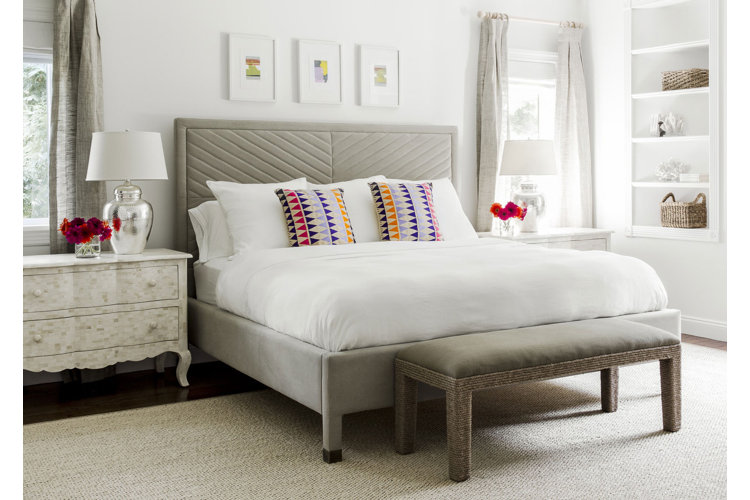
PHOTO: CHANGO & CO.
https://www.wayfair.com/shop-the-look/slp/--photo-id213159
Wake up on the right side of the bed every morning by making it enchantingly cozy for both sides—and whether you’re upgrading its size or simply its style, it all begins with the sheets. Find the trifecta of fiber, weave, and thread count that comprise your perfect sheet set with this quick crash course.
Tip! Register for sheet sets in multiples—one for the bed, one in the laundry, and perhaps even a fresh set stashed away in the linen closet.
Fiber
When it comes to feel, the fabric you choose can actually make more of a difference than any other feature (yes, even thread count!). Narrowing down your preferred fiber at the onset will also establish a clear starting point, helping you filter through all the style options out there with purpose.
Cotton
For that ever-soft, cool touch, nothing rivals 100 percent cotton—which also happens to wick away moisture as you sleep, won’t pill, and is less likely to stain than its synthetic counterparts. Long-fiber (or staple) cotton threads create an even more indulgent end result that the newly married deserve, so keep an eye out for sheets with that term, or Egyptian-quality, in the product description.
Linen
Another luxurious option, linen best for those who want a cool touch and natural, lived-in look (they're at their finest with a slight wrinkle). This option is made to stand the test of time—a high-quality set of linen sheets can last decades, as will its timeless appearance.
Silk
For couples seeking out a high-shine foundation and a warm touch, silk sheets are both a luxe and enduring choice.
Jersey knit
These soft and cozy sheets will be reminiscent of your favorite worn in T-shirt.
Weave
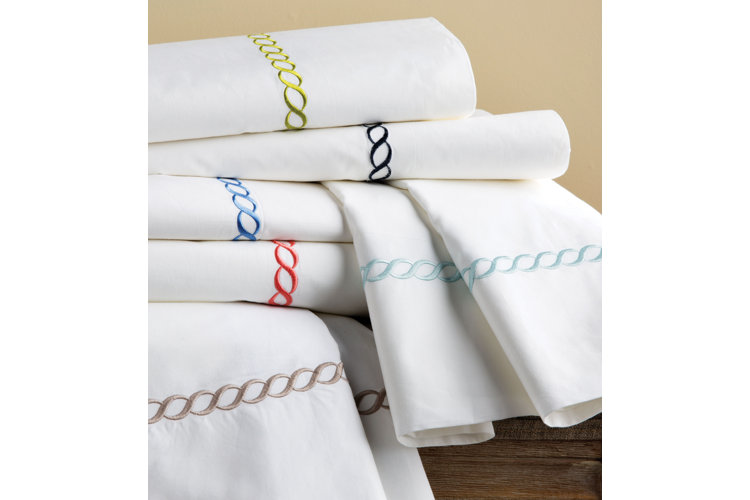
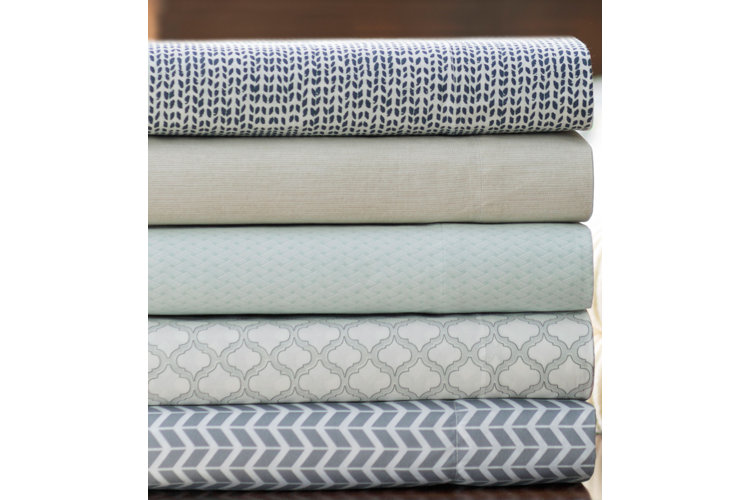
How the threads are constructed can enhance both softness and durability. There are four main techniques to consider—just remember, these aren't the only methods for introducing designs. Most sheets are colored (solid hues), printed (patterns), or embroidered (stitched-on stripes or helix) at the end for an added touch of personality.
Plain
The simplest weave, used in the majority of bedding, produces a strong, even fabric. Don't be fooled by its name though: Plain weave doesn't mean an unadorned finish. Pattern and embroidery abound—and pop—on these matte sheets.
For an upscale variation on the plain weave, look for percale. We love this closely woven fine cotton for its crisp feel and longevity—not to mention standard thread count of 180 or higher.
Sateen
Its thick, close weave produces silky smooth, lustrous bedding. The number of yarns exposed on the surface gives sateen its characteristic sheen—and explains why it’s sometimes confused with satin.
Twill
Easily identified by the diagonal lines on one side of the fabric, this technique yields a material that holds its shape and tends to be wrinkle-resistant.
Patterned
Featuring jacquard, damasks, or a repeating design woven into the face of the fabric (not printed on top of it), this technique requires a special loom to execute.
Tip! Most dyes are applied at that very end, meaning sheets won’t reach their full softness potential until after a few washes—unless you splurge for yarn-dyed fabrics.
Thread Count
The number of yarns per square inch when sheets are woven, thread count is often used to gage quality. And while a high thread count often denotes a higher quality, it's important to consider it as part of the trio—a lower thread count in a nicer fabric or finish will likely still feel better.
As a rule of thumb, look for sheets with a thread count of 200 or higher.
Tip! Looking for an expertly snug fit? Check the measurements of your mattress (including topper, if you have one) against the product description for the fitted sheet.
