What Are Custom Cabinets?
Customize your kitchen.
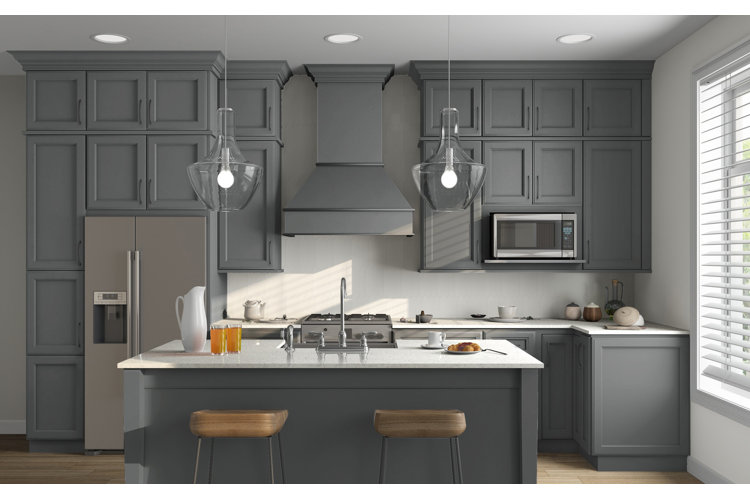
When considering the different types of custom cabinets for your kitchen, it’s essential to understand the various style and material options. If you’re not sure what custom cabinets are or why they might be the right fit for your remodel, read on to learn more and find the perfect cabinet for your kitchen.
Tip!
Questions on Wayfair’s custom cabinetry offering? Connect with a design expert to get started.
Why Choose Custom Cabinets?
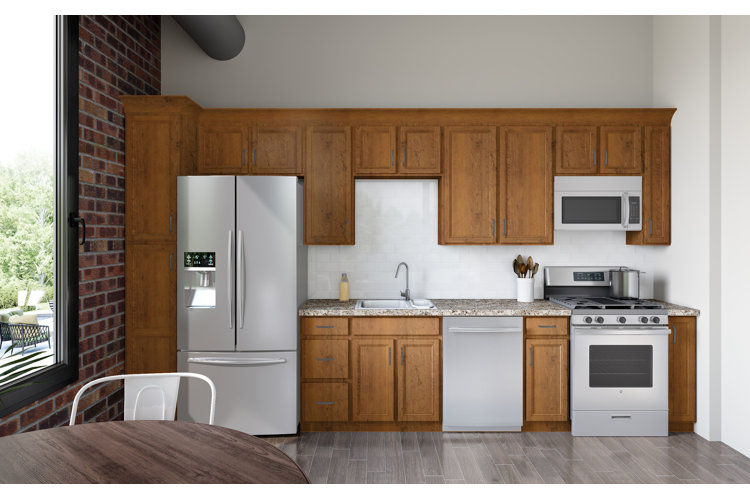
Custom cabinets are a popular alternative to stock and ready-to-assemble (RTA) cabinets. Custom cabinets allow for greater customization, higher quality, and expert advice along the way. Other options like stock cabinets, which arrive assembled, and RTA cabinets, which require assembly, are mass manufactured to standard cabinet sizes. Keep reading to learn why custom may be the right option for your home.
Custom Cabinets: The Benefits
- Made to Order: Custom cabinets allow you more finish, color, style, and size options than the traditional stock and ready-to-assemble offerings, enabling you to customize your cabinets to your unique style and preferences. Because the cabinets are made to order, they typically ship within 3 and 4 weeks (dependent upon industry lead times), but it will be so worth the wait.
- Quality Materials: Custom cabinet boxes are constructed from high quality wood materials, with soft close on the doors and drawers, dovetail drawer box construction, and a limited lifetime warranty.
- Expert Advice: There is no need to do it all on your own! Our cabinetry design experts will work with you to bring your custom cabinetry dreams to life. Custom cabinets cannot be returned, but your designer will guide you through the process and help you find the perfect cabinets for your home.
- Add-Ons & Accessories: Unlike stock and RTA offerings, custom cabinets give you the ability to add various accessory products so you can make the most of your new cabinets.
How to Choose Custom Cabinets
1. Determine the Type of Cabinets You’ll Need
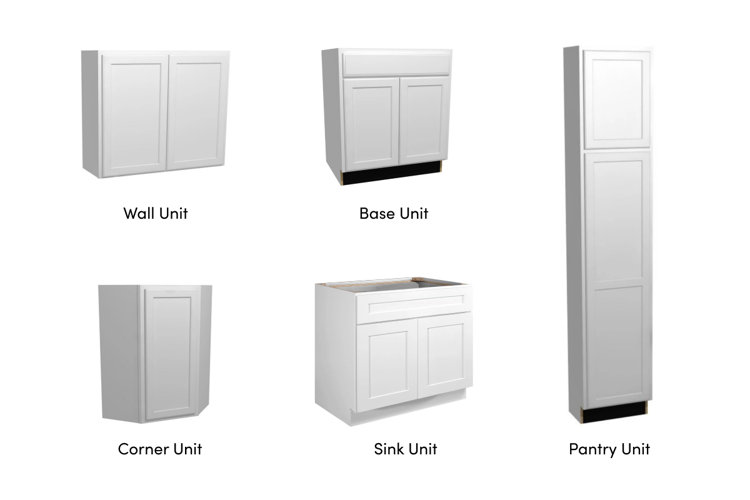
Finding the right types of cabinets for your storage needs will help bring your kitchen together.
- Wall Unit: These are placed on the walls of your kitchen – typically above a countertop or range – and are perfect for storing dinnerware, glassware, larger serving dishes, small appliances, and other everyday items.
- Base Unit: Base cabinets sit directly on the floor and are used to support your countertops. They are great for storing things that are heavy and you use regularly, like pots and pans.
- Pantry Unit: Pantry cabinets are taller than standard kitchen cabinets – adding vertical storage to your pantry space. They are most often used to store dry goods.
- Corner Unit: Corner cabinets can either be wall or base cabinets and they are designed to fit into the corners of your kitchens to maximize storage space. They often feature L-shaped or diagonal layouts for a seamless corner fit.
- Sink Unit: Similar to base cabinets, these rest on the floor. However, they are designed to pair with a sink so they provide space for plumbing holes in the back of the cabinet.
2. Compare Cabinet Materials
There are many different types of wood for kitchen cabinets to choose from. Keep reading to find the right material for your style.
- Hardwood: Hardwood is the highest quality cabinet material, making it a popular option for kitchen cabinets. It is typically used for cabinet face frames, the door, and drawer fronts. Hardwood is more expensive than other options, however, it is extremely durable and can be re-stained. Each piece of wood also has natural variation in color, texture, and grain patterns – making them a beautiful and unique addition to your home. Maple, oak, and cherry are common hardwood options.
- Plywood: Plywood, another popular material option, is constructed from thin slices of wood that are bound together with adhesive. Plywood is a great choice for cabinet sides, backs, shelves, and drawer bottoms. Plywood is also less prone to warping and works well in high-humidity homes and kitchens.
- MDF (Medium Density Fiberboard): MDF is a cost-effective alternative to hardwood and plywood cabinets. It is an engineered wood composite that is typically used for painted surfaces like the center panels on painted doors.
Particleboard: Particleboard is another cost-effective engineered wood alternative that is typically used for shelves and cabinet frames in stock and ready-to-assemble cabinets.
3. Choose a Cabinet Finish You Love
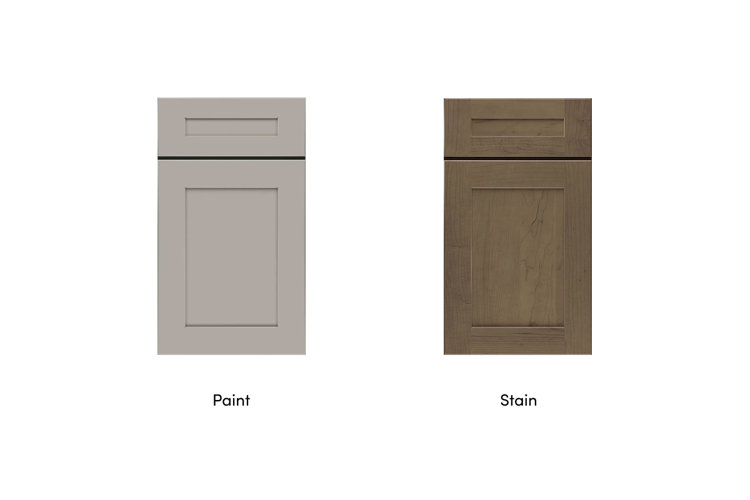
Depending on your home's style, you can choose between a variety of paints and wood stains.
- Paints: Painted cabinets do not showcase the knots and grains in the wood and instead have a smooth, uniform finish. With a variety of paint options to choose from (like white, cream, gray, blue, and more) you can customize your kitchen to your liking.
- Stains: Stained cabinets showcase the natural beauty of the wood. Lighter stains maintain more of the wood's natural character, while darker stains hide much of the grain, but create a richer color.
4. Check Out Different Door Design Options
Cabinet door designs can influence how the cabinets look in your kitchen. Choose a style that fits your kitchen’s overall look.
- Raised Panel: Raised panel cabinet doors are the most common door design. They have a center panel that is slightly raised to match the thickness of the door frame. The center panel is then bordered by recessed panels. Cabinets with raised panel doors are most often used in traditional-style homes.
- Recessed Panel: Recessed panel cabinet doors have a center panel that is lower than the rest of the door, with a higher outer edge. The door frame offers details in the profiles and contours. Cabinets with recessed panel doors will create a traditional or contemporary style within your home.
- Shaker Panel: Shaker cabinet doors use plain, unbeveled rails and recessed center panels providing simplicity, durability, and versatility. They are minimal in design and offer a clean and classic look.
Slab Panel: Sometimes referred to as flat panels, these have a flat panel with no raised or recessed features – offering your kitchen a clean and modern look.
5. Factor In Overlay Door Types
Cabinet doors can sit on a cabinet’s frame differently. Choose an option that best suits your style and storage space needs.
Partial Overlay: These are the most popular of the cabinet door types. They sit on top of the cabinet frame. A partial overlay cabinet can be opened without the need for additional cabinet hardware – giving it a sleek look.
Full Overlay: This design has the drawer or door covering the entire cabinet unit. Full overlay doors allow for more space inside the cabinet than inset doors because the doors sit on the outside of the cabinet frame. Keep in mind that these doors require cabinet hardware to be opened easily.
6. Pick Additional Features & Accessories
Custom cabinets are great because they allow you to fully customize your kitchen storage and aesthetic. Here are some customizable cabinet features to consider:
- Fillers: Fillers are pieces of wood that are used to fill gaps between cabinets to fit the cabinets to your exact kitchen dimensions.
- Toe Kicks: Toe kicks, or the area between the base cabinet and the floor, are an ergonomic design that allows you to stand more comfortably while at your countertop.
- Pantry Storage: Custom cabinets provide you with the option to add pantry storage solutions, for example pull-out drawers that maximize food storage.
- Drawer Organization: Declutter your counter space and make the most of your drawers with organization solutions such as utensil dividers.
- Pull-Out Bins: Hide your trash and recycling bins by adding cabinets with pull-out bins and baskets.
- Pots & Pans Organization: Add pots and pans organizers to provide easy access to your cookware, making cooking a breeze.
- Corner Cabinet Organizers: Add corner organization, such as Lazy Susan rotating shelves, to maximize storage space within corner cabinets.
