How to Pick the Right Custom Curtains
Add style to your room with the perfect custom curtains.
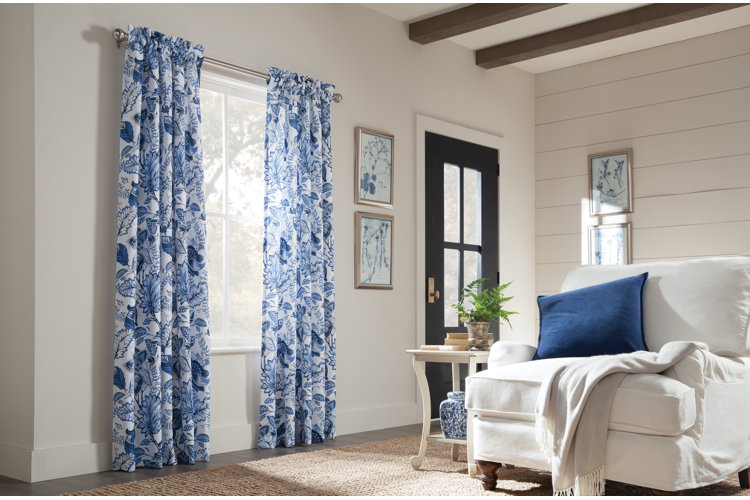
An easy way to pull a room’s style together? Curtains! Though most curtains come as prepackaged sets, for an even more unique style, you can order custom curtains. Designing custom curtains allows you to choose a pattern, header type, and size that easily complements your existing style. Learn how to pick the perfect custom curtains in our guide below.
In this guide:
Style
Fabric Light Filtration
Types of Curtain Headings
Size
Frequently Asked Questions
Style
Before you take measurements, choose the color and pattern of your new curtains. With endless design options, you can create the curtains that fit your space, needs, and style.
Design Tips
- If your windows are close to each other, a busy pattern may overwhelm the space.
- If you have bold rugs and furniture, opt for a subdued pattern, neutral color, or a color that blends in with your wall color.
- If you have neutral-colored rugs and furniture, consider curtains with a bold color or pattern.
- Light colors typically make the room feel more open and breezy, while dark colors make the room feel more formal.
Fabric Light Filtration
When choosing your fabric, consider light filtration – a measure of how much sunlight or street light the curtains will block.
Sheer/Semi-Sheer: These curtains allow the most light to filter in and don’t offer much privacy. However, they will reduce some glare. This style often lends a very soft and casual appearance.
Shop Sheer Curtains >>
Shop Semi-Sheer Curtains >>
Room Darkening: As the name states, room darkening curtains reduce the amount of light coming through, but some light may still seep around the sides of the curtain.
Shop Room Darkening Curtains >>
Blackout: Perfect for bedrooms or entertainment areas, blackout curtains block out the majority of light, provide privacy, and help block out sound. If you purchase curtains with thermal insulation, your room will also stay warmer in winter.
Shop Blackout Curtains >>
Max Blackout: These allow the least amount of light through – blocking out 99–100% of light. They also offer maximum privacy and reduce noise pollution from outside your home.
Shop Max Blackout Curtains >>
Types of Curtain Headings
A header refers to how a curtain is hung from the window hardware.
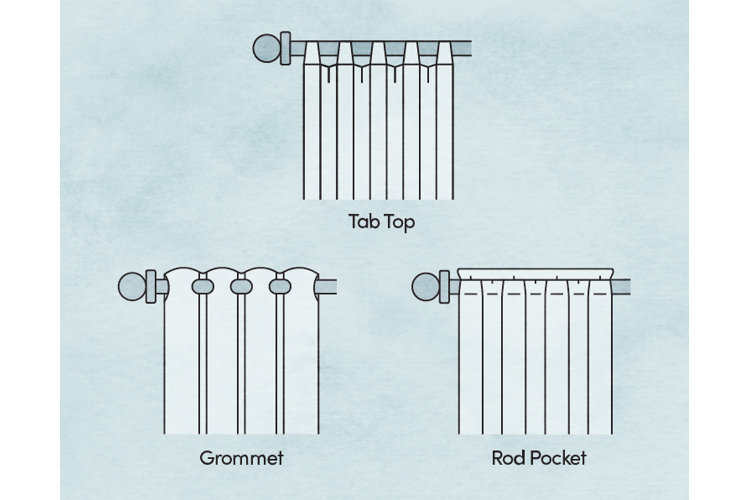
Tab Top
Tab top headers hang curtains and drapes through loops of fabric at the top of the panel. With this type of header, the panel hangs with the least amount of pleating or gathering.
Shop Tab Top Curtains >>
Grommet or Eyelet
This header offers a more modern feel as it hangs the curtains from metal, circular openings at the top of the panel. These are simple and leave the hardware exposed, so they are typically paired with a stylish metal or wooden curtain rod with decorative finials on the ends.
Shop Grommet/Eyelet Curtains >>
Shop Curtain Rods with Finials >>
Rod Pocket
With rod pocket curtains, the rod is simply inserted into the pocket that is sewn along the top of the panel. We suggest using this type of header on windows where the curtains will not be opened often. However, they can be left open with a tieback.
Shop Rod Pocket Curtains >>
Size
How to Measure for Custom Curtains
Determining the Correct Length
Step 1: Choose a length style: short, brushing, breaking, or pooling on the floor.
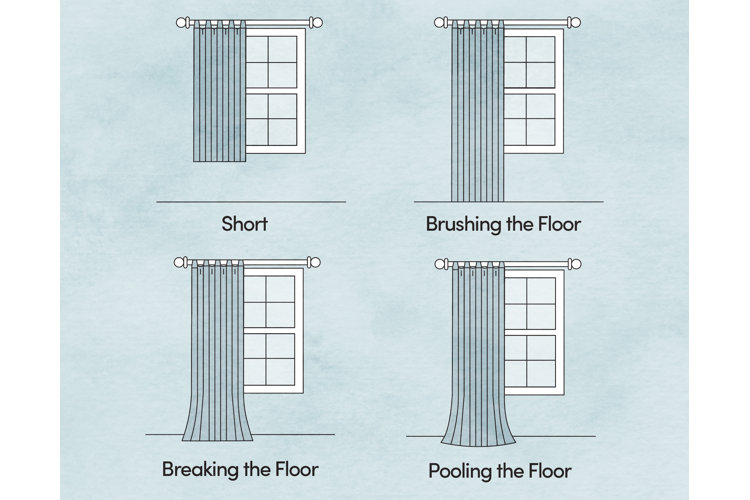
Short: Short curtains offer a more informal look. These are typically used in bathrooms or kitchen windows.
Brushing the floor: This length, which just touches the floor, is the best option for heavier fabrics like velvets and lined cotton. The curtains maintain their structure while also retaining their elegance.
Breaking the floor: The hem of the panel carries an inch or two over the floor. Consider this length if you're looking for a more relaxed style and softer look.
Pooling at the floor: Also known as "puddle length," this romantic style allows the panel to drape over the floor at two inches or more. This is recommended for curtains that will be used as decoration instead of curtains that will be pulled closed often.
Step 2: Depending on the type of header and length you want, you will need to measure accordingly.
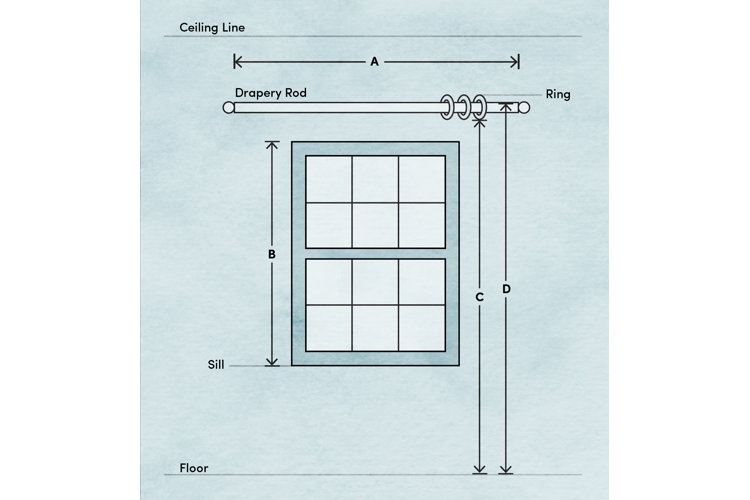
If you will have a rod pocket, tab top, or grommet header style curtain, measure from the top of the rod to the sill or floor. If you are using rings, measure from the bottom of the ring to the sill or floor.
If you want your curtains to brush the sill, measure from your curtain rod or rings to the sill, then subtract half an inch. If you prefer the curtain to be slightly under the sill, measure to the bottom of the sill and add 2" – 4". For your curtains to brush the floor, measure from the drapery rod or ring to the floor and subtract half an inch. If you want it to break the floor, add 1" – 3" to your length measurement. If you want it to pool the floor, add 4" – 6" to your length measurement.
Tip!
If you have a radiator below a window, make sure there is at least 2" between the top of the radiator and the bottom of the curtain to allow the heat to enter the room.
Determining the Correct Width
Before choosing a width, decide if you want your drapes to fully close or if you just want decorative panels.
For decorative side panels, measure from the edge of the curtain rod to the spot where you want your panels to hang in the window frame. Do this on either side, and add 4" – 6" (or find curtains that are 1.5x the width of this area) to allow the curtains to pleat properly.
If you want your curtains to cover the entire window, follow the steps below.
Step 1: Measure the width of your window. If you have a wall-mounted curtain rod instead of an inside-the-window rod, measure from the left edge of the hardware to the right edge (A, in image pictured above).
Step 2: Multiply the width of your window (in inches) by 1.5 or two to ensure curtains pleat properly. Triple the width for sheer curtains. Add only 12" – 24" for lace curtains so the pattern is displayed properly. Add 12" for pinch pleat curtains.
Step 3: Take the total width and divide that by the number of panels you want in the window. For example, if your curtain rod is 56" wide, multiply it by 1.5 (making that 84"), then divide that number by two, if you want two panels. Therefore, each panel should be at least 42" wide.
Tip!
Hanging curtains as high and wide as possible is a quick way to make the windows appear larger.
Frequently Asked Questions
What are the types of curtain headings?
The types of curtain headings are tab top, grommet or eyelet, and rod pocket.
How do I measure for pooling curtains?
For pooling curtains, measure from the rod to the floor and add 4" – 6".
When should I use sheer curtains?
Use sheer curtains when you want to allow more light in and prefer a soft, casual appearance.
