Hot Tub Pre-Delivery Guide
Congratulations on your new hot tub purchase!
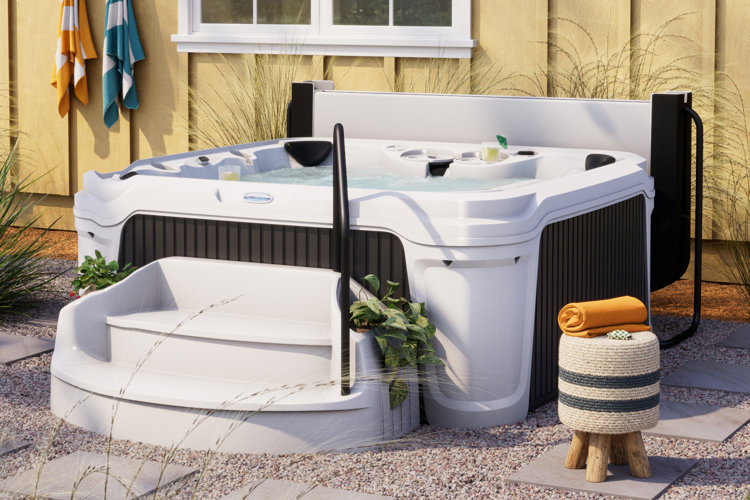
To ensure a seamless delivery and installation experience, please carefully review this guide. From choosing the right placement to understanding key setup requirements, it covers everything you need to be ready when your hot tub arrives.
1. Think About Pre-Installation Considerations
Having a plan for delivery day can make the process much smoother and help you prevent avoidable hiccups.
Plan Ahead: Key Details to Confirm Before Installation (more details on each below)
- Location: Will your hot tub be placed indoors or outdoors?
- Space Available: Is there enough room at your chosen site?
- Access Route: Will the hot tub fit through gates, doors, or stairways to get to your chosen site?
- Structural Support: Can your floor, patio, or deck handle the spa's weight (filled and unfilled)?
- Final Destination: How do you plan to move your hot tub from its curbside delivery location to your final destination?
- Electrical: Does this need to be professionally installed?
- Water Access: Is there a nearby hose hookup for filling and draining?
Frequently Asked Questions
Q: Do I need a building permit?
A: Most cities and counties require permits for exterior construction and electrical installations. Check with your local building or permitting office to confirm whether a permit is needed for your hot tub installation.
Q: Do I need a fence or gate around my hot tub?
A: In many areas, residential codes require safety barriers, such as fencing and/or self-closing gates, to prevent unsupervised access by children under five. Contact your local or county building authority to understand the specific requirements in your area.
Q: Do I need a plumber?
A: No. Your hot tub is self-contained and does not require plumbing. Simply fill it using a garden hose. To empty, you can siphon the water out using a garden hose or use a submersible pump.
Q: Do I need an electrician?
A: It depends on the type of hot tub you choose.
- 110V/120V plug-and-play hot tubs do not require an electrician.
- 220V/240V hardwired hot tubs must be installed by a licensed electrician.
- Convertible hot tubs (can be plug-and-play OR hardwired) will require installation by a licensed electrician should you choose for it to be hardwired.
2. Choose the Right Location & Foundation for Your Hot Tub
Whether you install your hot tub indoors or outdoors, careful planning of the location and foundation is essential. The surface must be solid, level, and capable of supporting the full weight of the hot tub, water, and occupants.
Foundation Requirements
Whether indoors or outdoors, a solid, level foundation is essential. The hot tub must rest flush and evenly on its foundation. Any uneven support can cause shell damage or void your warranty. The floor load of a hot tub filled with water is around 115 lbs. per square foot. Your base should have at least 125 lbs. per square foot load capacity.
Approved foundations include:
- Concrete Slabs: A reinforced concrete slab (typically 4–6 inches thick; minimum 4 inches) is ideal and must be perfectly level.
- Deck: If placing it on a deck, ensure the deck is structurally sound and built to support the significant weight of a filled hot tub (often over 5,000 lbs, depending on size). We recommend consulting a qualified builder or engineer.
- Pavers/Gravel: A properly prepared base of compacted gravel (4–6 inches) with a level paver or crushed stone surface can work for some models. Ensure adequate drainage.
- Foundations to Avoid: It’s best to avoid placing it on bare ground, grass, brick, stone, or dirt.
Note: Manufacturer warranties do not cover damage resulting from improper or insufficient foundation support. Do not attempt to level the hot tub by inserting wedges or supports beneath it, as this can lead to internal damage or shell cracking and will void the warranty. Always ensure the spa rests evenly on a properly constructed, level foundation.
Outdoor Placement
Outdoor installations are common and work well on concrete slabs, brick patios, or properly built wooden decks. Always verify your deck or patio’s load-bearing capacity. Standard decks with 2-inch x 10-inch joists spaced 16 inches apart are generally adequate, but we recommend consulting a licensed contractor and adding bracing if needed.
Many customers integrate their hot tub into a custom-built deck or patio. If you do, ensure the hot tub can still be removed for future servicing and that access panels remain reachable.
When placing your hot tub outside:
- Avoid installing under or within 12 feet of overhead power, cable, or telephone lines.
- Leave at least 30 inches of access space on all sides for servicing.
- Slightly elevate the hot tub to promote water runoff away from the base. When planning your installation, consider where the water will flow during draining for cleaning or maintenance. Make sure the drainage path will not flood your property, damage foundations, or affect neighboring areas.
Indoor Placement
If placing your hot tub indoors, ensure the floor is level and code-compliant, such as basement concrete or reinforced flooring. Additional considerations include:
- Ventilation: Use an exhaust fan (rated in CFMs, cubic feet per minute) to remove moisture and prevent damage to walls, ceilings, and furnishings. Use a humidistat for automatic control.
- Water-Resistant Flooring: Avoid carpet or wood. Use ceramic tile or waterproof material, extending at least 2 feet around the spa to catch splashes and moisture.
Fan Sizing Tip: Exhaust fans are rated by CFMs (cubic feet per minute). The fan must be powerful enough to remove all the air in the room in 3 minutes. To determine what size fan you will need, measure the room’s length x width x height and divide by 3 to get the CFMs. Example: 20 feet x 10 feet x 8 feet = 1600 cubic feet / 3 = 533 CFMs. You would need at least a 533 CFM fan for this room.
4. Get Ready for Delivery
Delivery day doesn't need to be stressful – these considerations can help you devise a plan that'll streamline the delivery. Advance planning ensures a smooth delivery and reduces the risk of delays, damage, or the need for unexpected adjustments on site.
Plan Your Delivery Path
Before installation day, carefully review the dimensions of your hot tub and compare them to all access points along the delivery route – including sidewalks, gates, doorways, and turning clearances. A clear, unobstructed path is essential to safely transport the spa to its final location.
Key considerations:
- Measure and compare spa dimensions with all entry points and turning angles along the route.
- Remove or temporarily modify gates, fence panels, or other barriers if necessary.
- Watch for low-hanging branches, eaves, gas or water meters, AC units, or any other potential obstructions.
Figure Out the Delivery Details
Your hot tub will be delivered curbside to the shipping address provided at checkout, unless you have upgraded to Backyard Delivery during checkout (only available on certain models). Delivery is handled by a common carrier or freight service, and the unit will be delivered on a pallet, positioned on its side in protective wrapping and packaging.
We suggest making prior arrangements to have your hot tub transported to your location of choice within your property. We recommend consulting labor professionals who have experience moving bulky and heavy items.
Key Considerations:
- Carrier: An independent delivery carrier will unload the hot tub from the truck but is not authorized to unwrap, position, set up, or install the unit on your property.
- Curbside Delivery: Your hot tub will be delivered curbside of the address provided at checkout. This is the standard delivery method for all models.
- Select Eligible Backyard Delivery: Select hot tub models are eligible for backyard delivery as an optional upgrade, available for purchase at the time of checkout.
- Electrical Installation Requirements: Many hot tubs require installation by a licensed electrician. Please confirm the electrical specifications of your spa and plan accordingly.
5. Review Electrical Requirements
Proper electrical installation is critical to ensure both the safe operation and long-term performance of your hot tub. Always consult the owner’s manual and installation instructions specific to your model before beginning installation.
When installed in the United States, the electrical wiring of this hot tub must meet the requirements of the National Electric Code (NEC) and any applicable state or local codes. The electrical circuit must be installed by an electrical contractor and approved by a local building/electrical inspector.
Important: Supplying power to the spa that does not meet these requirements will void both the manufacturer’s warranty and the independent safety agency listing. Always refer to your hot tub's installation manual for model-specific electrical specifications.
Check Your Hot Tub's Electrical Specifications
110V/120V Plug-and-Play Hot Tubs
- These hot tubs typically use a GFCI (Ground Fault Circuit Interrupter) cord as their power source.
- The unit must be connected to a dedicated electrical circuit at your main panel. This circuit must not be shared with other appliances, or the breaker may trip during operation.
- Do not use extension cords under any circumstances, as this can cause immediate breaker tripping and pose a serious fire hazard.
220V/240V Hardwired Hot Tubs
- These models must be installed by a licensed electrician. Failure to do so may void the manufacturer’s warranty.
- Installation must strictly follow the National Electrical Code (NEC) and all local code requirements.
Key electrical specifications:
- Must be wired to a dedicated, isolated 240V circuit rated at 30 or 50 amps (depending on your specific hot tub model).
- A GFCI-protected disconnect switch is required.
- All wiring must be permanently hardwired and installed in grounded conduit. Plug-in configurations are not allowed.
- Only copper conductors should be used. Aluminum wiring is not permitted and will void the warranty.
Convertible Hot Tubs (110V/120V to 220V/240V)
Some hot tub models are convertible, meaning they can operate as either a 110V/120V plug-and-play unit or be converted to a 220V/240V hardwired setup for enhanced performance.
If your hot tub is convertible, you must follow the appropriate electrical requirements based on the configuration you choose. Changing from 110V to 220V may also involve internal wiring adjustments within the spa cabinet. Please refer to your owner’s manual for instructions specific to your model. Always ensure any conversion is completed safely, correctly, and in full compliance with the National Electrical Code (NEC) and local regulations.
