Hollow Doors vs. Solid Doors: Your Comparison Guide
Make an informed door selection.
When it comes to choosing the right interior door for your home, the decision largely comes down to two options: hollow doors or solid doors. Each door type offers unique benefits and potential drawbacks. We've put together a comparison guide to help you understand the differences between hollow doors vs. solid doors and make the best choice for your home.
Hollow Doors vs. Solid Doors: The Pros & Cons
Hollow Doors
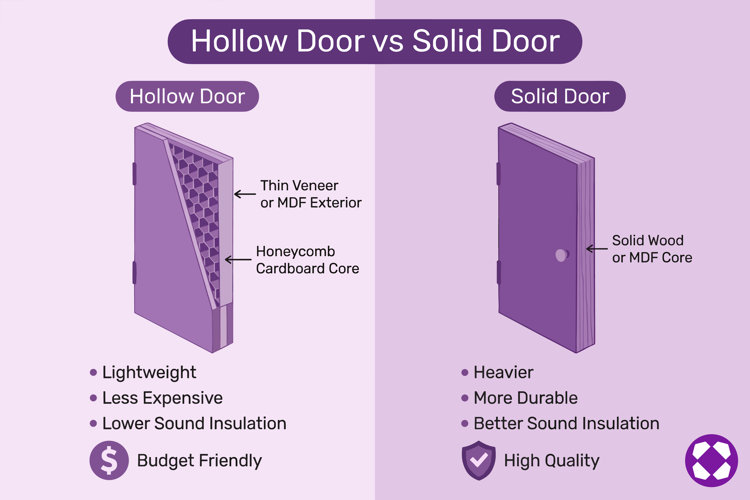
As the name suggests, hollow doors are not solid but have a hollow core. These doors are essentially a frame made from solid wood, and the interior is filled with a honeycomb construction of cardboard or fiberboard. The door is then finished with a veneer of high-quality wood or MDF (Medium Density Fiberboard) for a polished appearance.
Pros of Hollow Doors
- Cost-effective: Hollow doors are generally less expensive than solid doors, making them a great choice if you're on a budget or need to install multiple doors throughout your home.
- Lightweight: Their hollow construction makes these doors much lighter than solid doors, making them easier to handle and install.
- Easy to replace: If a hollow door gets damaged, it can be easily and cheaply replaced.
Cons of Hollow Doors
- Durability: Hollow doors can be prone to damage from impacts and are not as long-lasting as solid doors.
- Soundproofing: These doors don't provide as much sound insulation as solid doors, so they may not be the best choice if noise reduction is a priority for you.
When to Choose Hollow Doors
Hollow doors are best suited for interior areas where privacy and noise aren’t a major concern, such as closets or pantries. They're also a good choice for rental properties or budget renovations due to their cost-effectiveness.
Solid Doors
Solid doors are exactly what they sound like – doors that are solid all the way through. They can be made entirely of a single type of wood, or they can have a solid core of engineered wood or particle board that’s covered with a veneer.
Pros of Solid Doors
- Durability: Solid doors are highly durable and can withstand more wear and tear than hollow doors.
- Soundproofing: Thanks to their solid construction, these doors provide excellent sound insulation, which can be particularly beneficial in busy households or if the door is for a bedroom or home office.
- Feel: Solid doors have a high-quality, substantial feel when you open and close them.
Cons of Solid Doors
- Cost: Solid doors are generally more expensive than hollow doors due to the materials and craftsmanship involved.
- Weight: Solid doors are heavier than hollow doors, which can make them more challenging to install and may require stronger hardware.
When to Choose Solid Doors
Solid doors are best suited for exterior doors because they provide more security. They're also a great choice for bedrooms and bathrooms where privacy is important, or in busy areas of the home where they might receive more knocks and bumps.
When choosing between a hollow door vs. solid door, consider the location of the door, your budget, and your specific needs in terms of privacy, soundproofing, and durability. Remember, the right door for you is the one that best meets your unique needs and fits within your budget.
