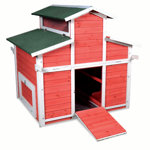
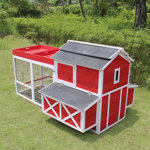
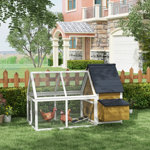
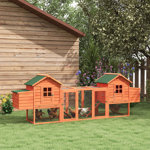
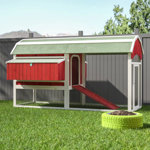
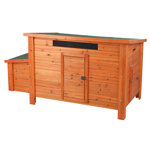
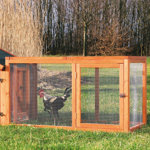
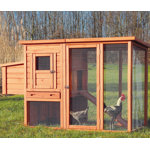
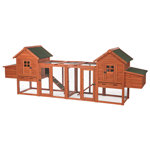
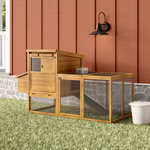
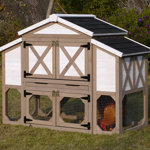
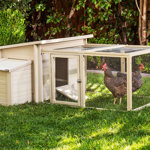
This is a great little coop for the price, if you know what you’re getting.
First, coop manufacturers tend to be incredibly liberal with their estimate on the number of birds any given unit can support. In this one, it’d be cruel to house any more than 2 standard size chickens or 3 bantams without either modifying the size of the run or putting your birds out to free rangepasture.
Second, expect to make some modifications to weatherproof and thwart predators. I used an exterior paintable silicone to caulk gaps ON THE OUTSIDE (wouldn’t want my birds pecking at or ingesting this stuff). Since this coop and run are made of unfinished wood, I used an exterior paint for the outside and a clear spar urethane for the interior, which I let fully cure. I went with the spar urethane rather than poly because it’s better formulated for water-resistance and humidity. There’s also a gap between the nesting box lid and the siding where water would easily penetrate directly into the coop. Here, I screwed in a 6” neoprene strip to deflect the water but not inhibit the opening and closing of the nesting box.
Third, the coop tray is hard to slide in and out. I sanded down the sides a bit just to make it a smoother pull and also added a handle for better grip.
Lastly, there isn’t enough hardware to make this thing “raccoon proof.” There were only 3 bar latches for the 2 doors and 1 hinged latch for the nesting box. I added a pin latch for the roof of the coop, an extra bar latch for the run door, and another pin latch for the top of the run (which also opens).
All in all, it’s a very good starter coop for a micro flock or, in our case, a transitional coop for our pullets before they move to the larger coop, and later, an isolation coop.
There’s also ThirdFinall